For Immunocompromised Patients and their Physicians
In January of 2023, the FDA revoked the Emergency Use Authorization (EUA) for tixagevimab-cilgavimab (Evusheld), the only prophylactic measure to prevent severe COVID-19 in immunocompromised patients, particularly those that don’t make adequate antibody responses to vaccines due to primary immunodeficiencies or due to immune suppression caused by underlying diseases and their treatments. Evusheld consisted of long-lasting monoclonal antibodies that could be administered twice yearly to protect this vulnerable population, but due to uncontrolled transmission among the general population, the SARS-CoV-2 virus had progressively mutated to the point that it was able to evade the neutralizing effect of these monoclonal antibodies and Evusheld lost its protective effect.
Yesterday (March 22, 2024), the FDA issued an EUA for a new monoclonal antibody (human IgG1) pre-exposure prophylaxis for these immunocompromised individuals.
This new preparation goes by the generic name Pemivibart and the brand name of Pemgarda. It is authorized for use in patients aged 12 years and older, so long as they weigh at least 40kg (88 lbs.) who have moderate-to-severe immune compromise such that they would not be expected to mount a sufficient (protective) immune response after COVID-19 vaccination. Pemivibart is not authorized for use in post-exposure prophylaxis or in treating COVID-19. Pemgarda is made by a company named Invivyd (Nasdaq: IVVD), formerly Adagio Therapeutics, (Nasdaq: ADGI).
Clinical trials (named CANOPY) began almost exactly one year ago. The interim data justified the granting of the EUA in the judgment of the FDA reviewers and advisors. The study was conducted with two arms. The first included an open label arm in which 300 participants (median age 59) with moderate-to-severe states of immunocompromise received 4,500 mg intravenously on day 1 and were re-dosed at day 90. The primary endpoints were safety, tolerability and 28-day post-infusion neutralizing antibody tiers against JN.1, the primary globally circulating SARS-CoV-2 variant.
The second arm (control group – median age 48) included 450 participants not known to be immunocompromised, but who were at high-risk of exposure to SARS-CoV-2 due to frequent unmasked indoor contacts with others. Of these 450 participants, 300 were randomized (double-blinded) to receive the same dosing of Pemgarda as the first arm participants and the remaining 150 received a placebo intravenously.
The first arm also consisted of individuals at higher risk for severe disease progression apart from their significant states of immunocompromise due to higher percentages of participants with significant comorbidities compared to the second arm, including diabetes, chronic kidney disease, chronic lung disease and underlying cardiac disease.
Of those that received Pemgarda, 623 participants for which data was available were reviewed. Four individuals (0.6%) experienced anaphylaxis (all in the first arm participants – half occurred with the first dose and the other half occurred after the second). Nine percent had systemic infusion-related reactions and hypersensitivity reactions, 6% experienced an upper respiratory infection other than COVID-19, 5% experienced infusion site infiltration/extravasation/vein rupture, 3% developed fatigue, 2% experienced headache, 2% developed nausea, and 2% developed local infusion site reactions.
As to the primary endpoint of neutralizing antibody titers, based on a prior study for a previous monoclonal antibody (and prior variants), a target neutralizing antibody titer of 8944 at 28 days post-infusion and 3514 at 90 days was used. [This is one limitation of the study in that we don’t know whether the same antibody titers are sufficient for more recent variants.] For those in the first arm (moderate-to-severely immunocompromised), the geometric mean titer at 28 days was 7365 and at 90 days (prior to re-dosing) was 3199. By using the antibody titer curves, it was projected that patients who receive Pemgarda would maintain neutralizing antibody titers above 3514 for approximately 77 days. It was estimated that neutralizing antibody titers would be approximately 33% higher on average following the first two doses if subsequent doses were administered on an every-three-month schedule.
Pemgarda is for intravenous administration only. It is dispensed in 500mg (4 cc) vials. The vials must be refrigerated and should not be shaken. It is dosed at 4500 mg IV every 3 months. The infusion should be administered over a period of at least one hour, and patients should be observed for two hours post-infusion. Due to the risk for anaphylaxis, Pemgarda must be infused under medical supervision in a setting where the resources are available to treat anaphylaxis and resuscitate a patient, and where emergency medical services can be activated and accessed.
Pemgarda is not renally excreted, so there is no recommendation to reduce the dose for renal insufficiency or patients on dialysis. The effect of hepatic insufficiency on the metabolism and clearance of Pemgarda is unknown, however, Pemgarda is not metabolized by cytochrome P450 enzymes, thus, it is not expected that coadministration of medications that are inducers or inhibitors of cytochrome P450 enzymes would affect the dosing or clearance of Pemgarda.
Has SARS-CoV-2 become a seasonal virus and has COVID-19 become a seasonal disease?
Just a quick reminder of what we have covered so far in this blog series entitled: A Comprehensive Update on SARS-CoV-2 and COVID-19. We are taking this opportunity to look back over the first four years of the pandemic and all the insights we have learned about SARS-CoV-2 – the virus that has caused this pandemic – and COVID-19 – the disease caused by the virus – to review our current understanding as the science has evolved.
In Part I, we reviewed what we have learned about the biology of the virus, itself. This will be helpful to our understanding of some of the future topics of this blog series as we get into issues concerning the pathogenesis of COVID-19, the immunology of the disease, some of the clinical manifestations of the disease, and the therapeutic options for COVID-19.
In Part II, we discussed the transmission characteristics of SARS-CoV-2 over three blog posts, including the transmission mode, the evidence for airborne transmission, the incubation period, the serial interval, the infectious period, viral shedding; transmission in classrooms, on airplanes and in health care facilities (nosocomial infection); and we concluded our review of the science with a critique of the new CDC Respiratory Virus Guidance.
We now move on to Part III to examine the question as to whether SARS-CoV-2 has become a seasonal virus and whether COVID-19 is a seasonal disease, such as influenza and RSV, which is a commonly held belief among the public and one that wittingly or unwittingly, the CDC seems to be promoting.
What does it mean for a virus and its infection to be seasonal?
Some viral illnesses demonstrate a pronounced seasonal variation in incidence. That does not mean that they cannot transmit at other times of the year, or even all year-long, however, these viral diseases show marked increases in transmission and disease incidence during certain months of the year. In classic cases, such as influenza, epidemic levels of transmission generally occur in the winter months, which is evident by increased transmission in the southern hemisphere in our summer (their winter) and by increased transmission in the northern hemisphere during our winter (summer in the southern hemisphere), which is actually helpful in our management of influenza by allowing us to identify strains of influenza circulating in the southern hemisphere ahead of our winter surge to assess and to predict how severe our influenza season might be, whether adults or children are being predominantly impacted with severe disease, and to anticipate the effectiveness of our influenza vaccine for that year.
Seasonal virus activity is generally limited to or predominantly displayed in temperate climates (climates in which there are warm to hot summers and cool to cold winters) as opposed to tropical climates (where the weather tends to be hot and humid year-round) or polar climates (where the weather tends to be cold year-round).
What does the epi curve for a seasonal virus look like?
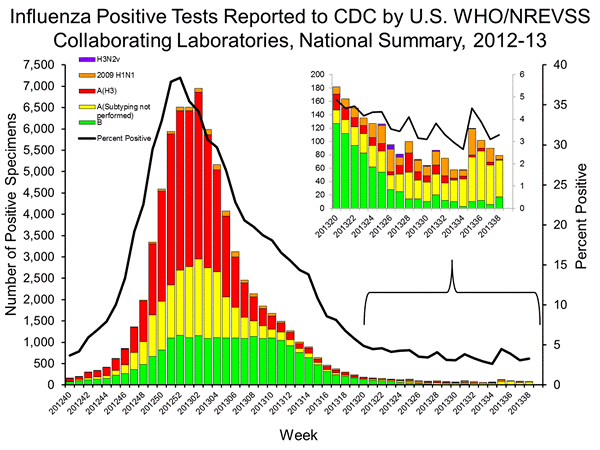
Influenza is a classic example of a seasonal virus. Let’s look at the epi curve for influenza in the U.S. during the 2012 – 2013 flu season:
Figure 1. Epi Curve for Influenza 2012 – 2013 season
Epi curves plot the number of cases along the y-axis (vertical; ordinate) in this case based on a positive test confirming influenza infection over time plotted along the x-axis (horizontal; abscissa) in this case by week. The CDC uses the convention of numbering the weeks from 1 – 52 (or in some years, 53) as so-called MMWR weeks, where the first day of each week is Sunday and the week numbered 1 is the first week of the year that has at least four days of the month of January in it. So, in Figure 1, the beginning time point is week 40 of 2012, which began on September 30.
The black line represents the test positivity rate for those presenting with influenza-like illnesses (ILI). With the beginning of fall, we see a number of seasonal respiratory illnesses begin to appear, so not everyone who presents with flu-like symptoms will have influenza infection, especially towards the beginning and the end of the season. So, for that week beginning September 30, we see that roughly 4 percent of those with ILI tested positive for influenza, meaning that the overwhelming majority of those presenting for evaluation were likely were infected with other respiratory viruses. Contrast that with the peak of the influenza season when almost 40% of those with an influenza-like illness will in fact test positive for influenza.
The bars of the bar graph indicate the number of persons testing positive for influenza and the colors indicate whether the influenza virus identified in those with positive tests was type A or type B, and for those samples for which subtyping was performed, we can see that the majority of the type A viruses were of the H3 subtype in that year’s influenza season.
As I mentioned above, seasonal viruses/infections don’t necessarily mean that there are no infections throughout the year beyond the season in which they surge, but rather that when there are, they are at low and relatively stable levels. We can see at the far-right part of our graph, following the fall/winter flu season, that transmission levels remain fairly low and stable with what appears to be less than 100 infections in the entire country each week.
So, going back to the left side of the graph, we can see that infections are gradually increasing above that baseline of less than 100 infections per week each week, until we begin to see a big jump around week 47, which would be the week of November 18, where cases are in the neighborhood of 1,500 (or more than 15-times higher than what we would typically see at baseline in the off-season for influenza) for that week. We then see that influenza cases peak during the second week of 2013, which would be the week of January 6th. Cases get down to the baseline level of less than 100 cases/week around the 26th week of 2013, which would be the week of June 23, but cases are down to the starting point of the surge that we saw on the left-side of this graph about six weeks earlier than that.
Now, the other thing about seasonal respiratory viruses is that we should see essentially the opposite pattern when we look to the southern hemisphere, and so let’s look at Australia’s influenza epi curve for the same flu season:
Figure 2. Epi curve for 2012 influenza season in Australia
Again, we have the number of infections plotted on the y-axis and the weeks along the x-axis, however, Australia does not use the MMWR week numbering system, which makes my life easier. So, for Australia (I picked that country because it is in the southern hemisphere and they do a very comprehensive program of influenza surveillance). We see that their baseline infection rate is below 100 per week as is ours, in fact, below 50 cases per week. We can see their seasonal influenza epidemic begins to take off right around the week of June 17. The peak in Australia was around August 12, approximately six weeks before cases in the U.S. began to increase and about 5 months prior to our peak. Recall that in the U.S. that year, our cases began to take off around November 18, which is past the time period shown in Figure 2, and after Australia’s seasonal epidemic has receded and essentially returned to baseline infection levels. This is why I look to what happens in Australia’s influenza season to get an idea of (1) how bad is our influenza season likely to be and (2) does it appear that the influenza vaccine is a good match based on the subtypes of influenza identified circulating in Australia during their flu season.
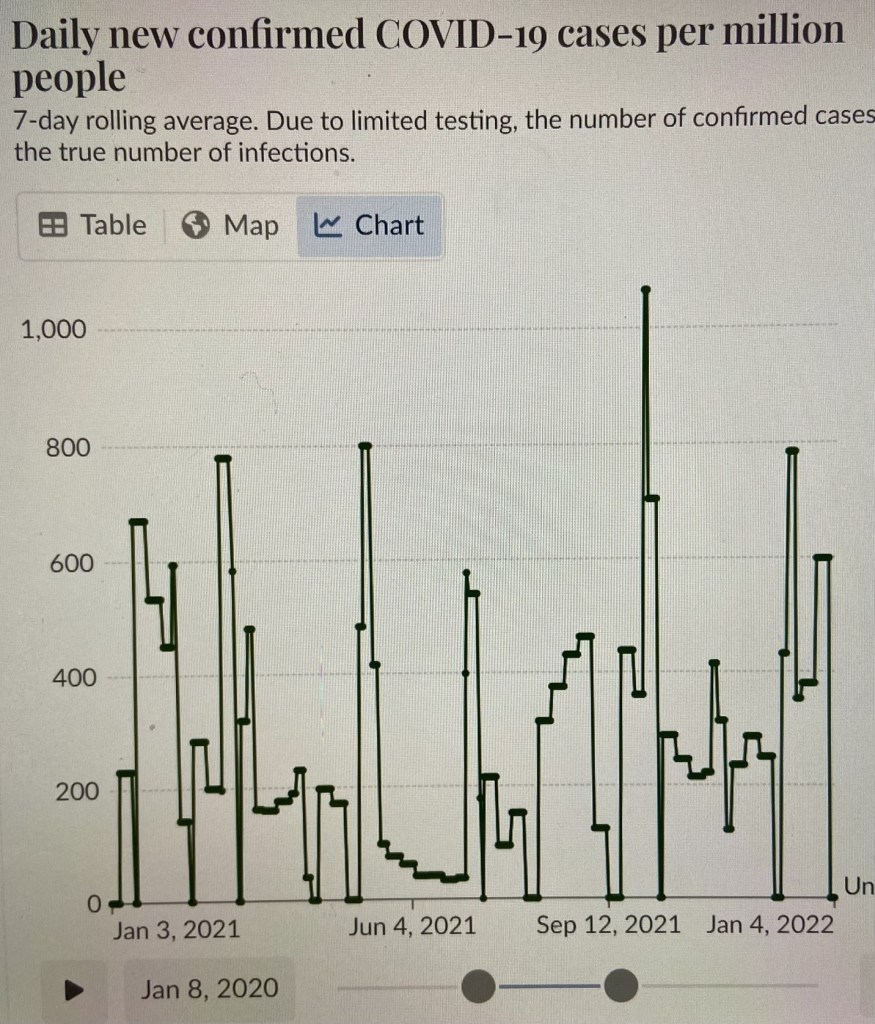
So, those are epi curves for a classic seasonal virus. Let’s look at the epi curves for SARS-CoV-2/COVID-19. We will start with Figure 3 – the COVID-19 epi curve for the U.S. I selected the time period of January 3, 2021 through January 4, 2022, because we were still testing and reporting cases on a regular basis.
Hopefully, as you look at Figure 3, you see that it is quite different than the epi curves we examined in Figures 1 and 2 with a seasonal virus. In Figure 3, we see that the number of confirmed cases of COVID-19 appear in successive surges throughout the year reaching peaks in the third week of January, an even higher peak in the first week of March, a just slightly higher peak in the middle of May, another peak, though lower, in the first week of July, another peak at the end of August/beginning of September, the highest peak of the year at the beginning of October, a much smaller peak during the first week of November, and then a peak comparable to the peaks in March and May that occurs in the middle of December. In other words, we see peaks in all four seasons, so this quite clearly is not a seasonal virus or disease.
Figure 3. Epi curve for COVID-19 confirmed cases in the U.S. 1/3/21 – 1/4/22
What if we look to the southern hemisphere for the epi curve for COVID-19? Let’s examine Australia’s epi curve for the same time period:
Figure 4. Epi curve for COVID-19 in Australia
Figure 4 is the same time period as Figure 3. Notice the peaks in Australia occurred the middle of March, the middle of May, the middle of July, the third week in September, the middle of October and then a huge peak immediately following Christmas. Notice that unlike for influenza, for COVID-19, the peaks are occurring roughly at the same time in both hemispheres, even though the magnitudes of those peaks are different, likely due to different mitigation measures, different COVID-19 vaccine schedules and roll-outs, and different infection histories. Nevertheless, SARS-CoV-2/COVID-19 clearly are not seasonal.
What factors contribute to a virus being seasonal?
We don’t have a full understanding as to all the factors contributing to seasonality in the transmission of some viruses, and why we can see slight changes from year-to-year, and why some viruses of the same family have slightly different times of seasonal increased transmission (e.g., the seasonal common cold coronaviruses). Nonetheless, there is much we have learned. Seasonality can be impacted by biological properties of the virus, biological properties of the vector or intermediate host, biological properties of the ultimate host, weather changes, and human behavior.
We have known for some time that weather conditions can affect transmission levels for some viruses, though the relative contributions of biological properties of the virus, such as temperature, humidity and UV light sensitivity of the virus versus the role played by changes in human behavior – school year, travel over holidays, gathering in close quarters, etc. is often subject to differences of opinion. Interestingly, many of the commonly occurring respiratory virus infections, e.g., influenza and RSV, tend to peak in the winter months, while many of the viruses that cause rashes in children that are transmitted by the respiratory route tend to peak in the spring. For example, measles tends to peak in late winter and early spring in temperate climates. However, in the tropics, the peak incidence of measles tends to be late in the dry season, with an abrupt decrease when the rainy season begins. In contrast, influenza and rhinovirus infections tend to peak in tropical climates during the rainy season.
Examples of differences in biological properties of viruses include measles, influenza and vaccinia viruses that survive in air better at low humidity compared to viruses like polioviruses, rhinoviruses and adenoviruses that survive longer in high humidity environments. However, even this can be confounded by changes in host biology such as when they have drying of their nasal passages and oral cavities due to the low humidity of air conditioning and central heating.
The movement of large numbers of people indoors in poorly ventilated buildings during the cold winter months is an example of human behavior that may promote the transmission of airborne respiratory viruses.
On the other hand, viruses transmitted by vectors such as mosquitoes or sand-flies (most notably arboviruses) show seasonality (summer months), not so much because of intrinsic properties of the virus, but because of the life cycle of the mosquitoes and sand-flies that carry and transmit the viruses to humans. However, the seasonality and geographic area where disease occurs can also be affected by the host animal. For example, the host of the West Nile virus is predominantly birds (humans are incidental hosts). The virus circulates at high levels in the blood of the affected birds (in many species, but most notable in crows because of the high mortality rate for crows that leaves visible evidence of their carcasses when there are high levels of circulating West Nile virus). The intersection of the time when mosquitoes hatch and are active and the location of these bird species during the time mosquitoes are active (e.g., before migratory birds have headed south) in part explains the predominance of this disease being primarily transmitted in the Great Plains states between the months of July and October.
Similarly, viruses transmitted by ticks most commonly tend to be transmitted in the spring and early summer or in the fall based on the life cycle of the tick. As one example, the virus that causes Powassan disease is carried by the deer tick (Ixodes scapularis) most often produces cases in the United States occurring in the northeast and Great Lakes regions from late spring through mid-fall when ticks are most active:
Figure 5. The life cycle of the Ixodes scapularis tick.
I hope that I have made a clear case, provided you with our current understanding of what contributes to seasonality of some viruses, and shown you the data that demonstrates that COVID-19 transmission cycles throughout the year (we’ll discuss why we think that happens in the next blog post that follows) rather than with seasonality. Of course, it is always possible that in the future that SARS-CoV-2/COVID-19 could become seasonal, but it clearly is not at present (while I showed you data from 2021 because we had good testing and reporting, if you were to examine time periods since then, you still see the year-round transmission with regularly recurring peaks, as opposed to the low and stable level transmission you can see with a seasonal virus like influenza).
Transmission Characteristics of SARS-CoV-2 and the CDC’s New Respiratory Virus Guidance
To refresh ourselves on this blog series, in Part I, we reviewed what we have learned about the biology of the SARS-CoV-2 virus. In Part II, we began the discussion of the many things we have learned about the transmission characteristics of SARS-CoV-2.
We first discussed the mode of transmission, namely aerosols, or what we would call airborne transmission, and I provided you some of the evidence gained that confirms that this is the dominant mode of transmission, as opposed to early reports by the WHO and CDC that the dominant mode of transmission was respiratory droplets. As I explained, this is not a minor difference. Airborne transmission poses far greater risks to more people than respiratory droplets and the mitigation measures are far different. In fact, the only way superspreader events occur, which we saw many examples of, is through airborne transmission.
We then discussed the incubation period determined at the beginning of the pandemic being between 2 – 14 days with the median being 5 days. I introduced the concept of the serial interval and how in the case of this virus, we can establish that infected people may transmit the virus for 1 – 2 days prior to the onset of symptoms. We also looked at how this data, plus the available data on viral shedding, served as the basis for the CDC’s isolation (infected person) guidelines of 10 days and the quarantine (exposed person) of 14 days.
We also discussed the revision of the isolation guidelines towards the end of 2021 as hospitals were facing the prospects of being overwhelmed and going on crisis standards of care during Delta and subsequently at the beginning of 2022 with Omicron, a problem that would be magnified if health care workers had to isolate for 10 days.
Finally, we looked at another aspect of transmission – nosocomial infection (infection of staff and patients in health care settings).
It just so happens that since the last blog post, the CDC has revised its isolation guidance again. This gives us the perfect opportunity while we are reviewing our accumulated knowledge and the science around the transmission characteristics of the virus, to evaluate the soundness of the new guidelines.
But, before we do, let’s review an article on viral load and viral shedding. Unfortunately, I am not aware of recent studies with the latest variants, but the few government or former government leaders of the pandemic response who have spoken on this issue have made the assertion that the science has not changed (personally, without more recent studies, I don’t know whether it has or not) and certainly, in the supporting document in which the CDC explains its rationale for this new guidance, no new evidence or studies are cited that I might have missed. Recall that the major way for us to determine whether someone remains infectious and for how long is to assess how long they shed virus (see the end of the very first blog post on transmission characteristics).
SARS-CoV-2 viral load and shedding kinetics | Nature Reviews Microbiology was published in December of 2022. As the authors point out, “SARS-CoV-2 viral load and detection of infectious virus in the respiratory tract are the two key parameters for estimating infectiousness.” Recall that viral load is the amount of virus one has (directly measured and expressed as the numbers of copies of virus per milliliter of transport fluid [the liquid in the tube that the nasal swab is inserted into] or indirectly measured and reported as the cycle threshold [CT value] on a PCR test), based on the principle that someone whose nose and throat are teeming with virus is much more likely to infect another in close contact than someone whose nose has very few copies of virus in it. Again, you can get a refresher on these tests in the first blog post of Part II of this blog series. Be sure not to get confused. The higher the direct measurement (copies of virus/ml), the higher the viral load, but the lower the indirect measurement (CT value), the higher the viral load [each cycle amplifies the amount of nucleic acid until it can be measured, so the fewer times the sample has to be amplified, the more virus you started with, hence the higher viral load).
By conducting serial determinations to detect infectious virus in a large group of infected subjects, it is then possible to provide a range for the “infectious period,” the time period following infection in which the infected person is able to transmit the virus and infect another person.
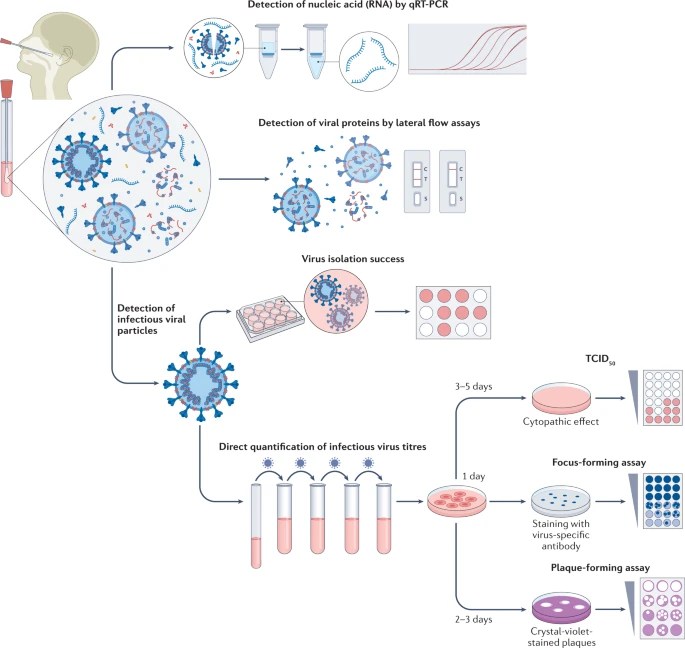
PCR (polymerase chain reaction) tests (these are the tests that were first available that you generally had to go to a doctor’s office, urgent care or hospital to get and that usually took days to get results back) can be used to confirm infection (as these tests have good sensitivity [will identify that you have the infection if you are infected] and good specificity [if the test is positive, it is highly likely that it is infection with SARS-CoV-2 and not something else], but we will discuss these tests in more detail later in the blog series when we get to the updated data on tests), and they can be used as surrogate measures of viral load, as explained above. These tests are of limited value for measuring viral shedding, because they cannot distinguish between infectious virus and viral debris remaining from the body’s immune attack on the virus and/or treatment with antivirals or monoclonal antibodies.
On the other hand, the rapid antigen tests (RATs) [these are the tests that the government would send to your house if you ordered them or that you could buy at the drug store] are a better (though not perfect) test for detecting infectious virus, but they don’t tell us much about viral load. As I mentioned in the first blog piece of Part II, the gold standard for determining infectiousness is actually growing the virus in cell culture from a patient sample or looking for evidence of cell infection when healthy cells are mixed with virus obtained from the patient in culture. However, these tests are only performed at highly specialized laboratories, under enhanced biosecurity measures, are more expensive to conduct, and take far more time to conduct.
At the beginning of the pandemic, viral load studies of patients with mild disease showed that the viral loads (and presumably infectiousness) were highest in the first 5 days of the illness, with the peak often occurring at the day of onset of symptoms, or even 1 – 2 days prior to the onset of symptoms. The viral load would most often continue to decline over the two weeks following the onset of symptoms, however, the preponderance of evidence suggested that, in immunocompetent individuals, who only had mild disease, infectious virus was rarely detected beyond day 10 following the onset of symptoms (hence the justification for the isolation guidelines that used 10 days).
Figure 1. Viral kinetics of the ancestral (wild-type; original) virus
Looking at Figure 1, we see the days since symptom onset along the x-axis (abscissa, horizontal axis). Day 0 is the day that symptoms first appeared. The viral load is plotted along the y-axis (ordinate, vertical axis).
Recall that at the beginning of the pandemic, the mean incubation period was 5 days (see first blog post of Part II of this series). Thus, at 5 days prior to onset of symptoms (-5), the designation of “infection” is made. This is the point, on average, at which the subjects being plotted out on this graph were exposed to an infected person and then became infected themselves.
The PCR test won’t become positive until the infecting virus is replicating in the nose and throat and producing enough copies of virus that the nucleic acid (the RNA sequence) of the virus can be detected with amplification on this test, which is often prior to the onset of symptoms and about a day before the rapid antigen tests will be able to detect the presence of viral antigens (proteins) [note that I use the more common reference to these tests as rapid antigen tests, but this paper uses the reference to these tests as antigen-detecting (rapid) diagnostic tests (Ag-RDT) – a reference that is less commonly used].
The symptom-onset falls within a window to reflect that in a population of people, some have incubation periods (infection-to-onset of symptoms) that is shorter (as short as 2 days) and others have incubation periods that can be much longer.
What this diagram illustrates is that the viral load (and the number of virus RNA copies and the amount of infectious virus) is generally highest right around the time of the onset of symptoms, however, note that the person may have high levels of infectious virus both a day or two prior to the onset of symptoms, as well as beyond the period of symptoms, though that level of infectious virus is declining as the symptomatic period is ending.
The duration of symptoms is highly variable. Some people (early estimates were 33 – 40% of all those infected) were asymptomatic, either because they had not yet developed symptoms by the time their infection was detected, or because they never developed symptoms, yet, they clearly could transmit the virus and infect others. Some people only had symptoms 1 – 2 days, and others might have lingering symptoms. The time period during which the rapid antigen tests remained positive reasonably well correlated with the period of infectiousness, however, the correlation to symptoms was not well correlated.
The elimination or clearance of infectious virus correlates with (remember that “correlates with” is not synonymous with “caused by”) the production of the body’s antibodies. Generally, antibodies are produced in response to a newly recognized antigen as early as in 5 days, but generally there is a maturation process in which these antibodies change type (we will discuss this in a later blog post when we explore the immune response) and also become higher-affinity antibodies (bind to their targets more tightly), which progresses over time, but becomes evident by around day 10.
The above data points displayed in Figure 1 are for immunocompetent persons with mild-moderate illness. We know that those who develop severe disease can have high viral loads extending into the second week of illness, which is generally when we see deterioration in those who develop severe disease, and we also know that immunocompromised persons can have extended periods (weeks to months) of persistent infectious virus.
What is unknown (at least to me because I have not found more recently conducted studies) is whether the infectious period has decreased with the priming of this immune response by either prior infection or vaccination or both, but that would seem to be a reasonable hypothesis. On the other hand, although there are few studies with limited data as to when the infectious period ends, based on that limited data displayed in Figure 2, I am not confident that my hypothesis is valid. Further adding to my doubt is vaccine studies that have tended to show that vaccinees develop lower viral loads with breakthrough infections, but do not have shorter durations of shedding of infectious virus.
Figure 2. Shedding kinetics for different variants.
Figure 2 illustrates that while there was a shortening of the incubation period for Delta (summer/fall 2021) and even more for Omicron (beginning of 2022 through today), and Delta tended to produce higher viral loads than either the ancestral or Omicron variants, there isn’t much support for the period of shedding of infectious virus being shortened significantly.
As we critically examine the new CDC guidance, an important issue will be the correlation between symptoms and infectiousness. I already provided my observation above. Let’s look at what the authors of this study state:
“Considering that high viral loads can be detected in the URT (upper respiratory tract) of infected individuals regardless of their clinical manifestations, the presence of symptoms is an unreliable indicator of infectiousness. (emphasis added) Notably, individuals infected with SARS-CoV-2 can be infectious before the onset of symptoms, and it was estimated that about half of secondary transmissions take place in the pre-symptomatic phase.”
At this point, you should have a good understanding of the mode of transmission (airborne; aerosols), the incubation period (the time from exposure and infection until the onset of symptoms), the concepts of viral load (the amount of virus in their nose and throat), the period of viral shedding (the time during which there is the continued presence of virus detected in the nose and/or throat), and how we make determinations as to whether that virus is infectious (replication competent) virus. We are now ready to examine the new CDC isolation guidelines.
“CDC’s updated guidance streamlines recommendations for dealing with a range of common respiratory viral illnesses.”
My first reaction is that the CDC is perpetuating a troublesome analogy that COVID-19 is able to be treated like (and by implication, is analogous to) other “common respiratory viral illnesses.” The problems with this include:
Most “common respiratory viral illnesses” are seasonal. COVID-19 is not, and I will have an upcoming blog post with the evidence to demonstrate that it is not. This is dangerous because many people will let their guard down during the majority of the year that is not respiratory virus season if they subscribe to this thinking. Much more on this in upcoming blog posts.
Most experts who have studied the SARS-CoV-2 virus and the disease it causes realized more than a couple of years ago that COVID-19 is not limited to the upper respiratory tract like many common respiratory viruses, or even to the lungs, as in the case of more severe respiratory viruses. SARS-CoV-2 is much more of a systemic viral illness, characterized by endothelial cell damage, potentially serious neurologic manifestations, a much higher rate of post-viral syndrome (in this case, Long COVID or PASC) than is seen with other viruses, and many other long-term health consequences that we will review in depth in upcoming blog posts.
“The updated recommendations continue to protect those most at risk for severe illness.” We’ll discuss this after we look at the specific recommendations so that you can draw your own conclusion, however, I am worried that this will do exactly the opposite.
So, once again, we see the effort to blend SARS-CoV-2 in with other “common respiratory viruses” like “flu” and RSV: “Each year, respiratory viruses are responsible for millions of illnesses and thousands of hospitalizations and deaths in the United States. In addition to the virus that causes COVID-19, there are many other types of respiratory viruses, including flu and respiratory syncytial virus (RSV).”
What are the public health challenges with lumping SARS-CoV-2 in with other common respiratory viruses?
To the general public, when you mention the phrase common respiratory viruses, the majority are going to think of cold viruses, something that kids and most adults don’t worry about, don’t take any precautions to avoid, and don’t associate with any long term health consequences.
We have four “common cold” coronaviruses, and this new guidance promotes the prevailing notion among the public that viruses inevitably evolve to become milder (a rule that numerous viruses don’t follow – e.g., HIV; hepatitis A, B and C viruses; influenza viruses, Ebola virus, SARS-CoV, MERS-CoV, and measles virus to name only a few) and thus many will see this message as reinforcing the notion that the SARS-CoV-2 has evolved to become a fifth common cold coronavirus.
This will also perpetuate another popular misunderstanding among the public that the SARS-CoV-2 is now a seasonal respiratory virus like the other common cold viruses that the public is familiar with, and particularly because the CDC decided to explicitly mention two respiratory viruses that are clearly seasonal – influenza (except during influenza pandemics) and RSV. An upcoming blog post will provide the current evidence for why SARS-CoV-2 is not a seasonal virus. This will likely result in many people relaxing their precautions outside of the late fall and early winter months, and not testing and in appropriate cases not seeking antiviral treatment for a “summer cold” or assuming that their symptoms in March, May or July must be allergies.
We already have trouble getting people to take the influenza vaccines, and this messaging that associates SARS-CoV-2 with other seasonal respiratory viruses may further impede public health messages to get vaccinated. For example, during the 2020 – 2021 influenza season, at time when we were going through the first year of the COVID-19 pandemic, when COVID vaccines were not yet broadly available, a time when one would think interest in influenza vaccines might be among the highest, the CDC reports that vaccination coverage with ≥1 dose of flu vaccine was 58.6% among children 6 months through 17 years, a decrease of 5.1 percentage points from the 2019–20 flu season, and flu vaccination coverage among adults ≥18 years was 50.2%, an increase of 1.8 percentage points from the prior season. https://www.cdc.gov/flu/fluvaxview/coverage-2021estimates.htm.
Let’s compare just one of the public health impacts of COVID-19 and “common respiratory viruses” – Deaths:
Influenza (2010 season – 2019 season) – the lowest number of influenza-related deaths in the U.S. was 12,000 in the 2011 season and the highest number of deaths was 51,000 in both 2014 and 2017. https://www.cdc.gov/flu/about/burden/past-seasons.html.
COVID-19 – the CDC reports (and a later blog post will explain why these numbers understate the actual number of COVID-19 deaths) 1,181,607 COVID-19 deaths in the U.S. since the start of the pandemic (2020 – now). If we look at the most recent full year of data (2023), a time when the CDC is saying that this is no longer the emergency that it once was in that we have much higher levels of immunity due to vaccination, prior infection or both, we still lost 75,232 Americans to COVID-19. https://covid.cdc.gov/covid-data-tracker/#trends_weeklydeaths_select_00.
Another challenge is that instead of providing focused guidance for the prevention of COVID-19, they now lump all the prevention guidance together. Hygiene and Respiratory Viruses Prevention | Respiratory Illnesses | CDC. This is problematic because while some of the advice that is appropriate for common cold viruses such as hand hygiene, cleaning surfaces, and covering coughs and sneezes is good general advice, it is wholly inadequate in preventing the transmission of COVID-19. I still have people inquiring as to whether they should wear gloves or wipe down packages because they remain confused about the transmission mode of SARS-CoV-2 based on earlier CDC messaging concerning it. To understand how inadequate these measures are, review the first part of the Part II blog post in which I discuss the mode of transmission for this virus.
The CDC in essence eliminates the isolation guidance and replaces it with:
“You can go back to your normal activities when, for at least 24 hours, both are true:
Your symptoms are getting better overall, and
You have not had a fever (and are not using fever-reducing medication).”
One immediate criticism I have is that the CDC does not define what a fever is, or if they do, I didn’t see it. Secondly, we don’t have very good data on this, especially with newer variants, but even at the beginning of the pandemic, we only saw fever in 81 – 82% of patients with mild – moderate COVID. I certainly have the impression from many of the people who have consulted with me about their infection or a family member’s infection recently, that number may be less now. Further, all the examples they provide are ones in which the patient has fever. Fever does not correlate well with the infectious period, so it seems unwise to place so much focus on that one sign and potentially inadvertently send the message that if they don’t have fever, then they may have a mild case (none of the case definitions for severity of illness include fever as a criterion) and might suggest to them that they are not infectious.
So, one can look back at Figure 1 so that you can draw your own conclusion, however, here is my critique of this advice as applied to the case of COVID-19:
Many people’s symptoms with COVID-19 are the worst on the 1st day – day 0 in the figure. On day 1, the majority of people will feel “better.” However, look at where we are on day 1 in terms of infectious virus and the levels of infectious virus for the next week. Thus, a lot of employers may expect their employees to return to work the next day or two after symptoms begin, and a lot of employees and students may believe it is fine for them to return to work or school then, yet they may remain infectious for just over a week. And, let’s face it, few employers and schools have implemented the air handling guidance I commended above.
Now, I don’t want to just criticize. I will explain what I would believe the current state of the science (though I admit it is inadequate and not updated, but it all any of us have to go on) would support: returning to work or school when your symptoms (perhaps other than fatigue) are largely resolved (as opposed to improving) and a rapid antigen test is negative.
Now, to be fair, the CDC’s guidance goes on in the next paragraph to state:
I have already commended the CDC for the “steps for cleaner air” and criticized the “hygiene” guidance at least to the application to COVID-19. How about masks?
When you click on that page, you are presented with this picture:
At this point, all of the aerosol scientists have just fallen out of their chairs and had a seizure. We have known for years now that surgical/procedural masks are wholly inadequate to protect their wearer or others from highly transmissible airborne viruses. Like the hand-washing and cleaning of surfaces, this will make people feel like they are doing something, but not protect anyone. We will do a deep dive into what we have learned about masks in an upcoming blog post, but you can see from this picture a number of problems, but I will point out just a few. The SARS-CoV-2 virus is much smaller than the diameter of one of the hairs making up his beard. Look at the bridge of his nose. See any gaps that are wider than the diameter of a hair? Keep in mind, when breathing through his nose, air will be preferentially directed through the path of least resistance – the gap around the bridge of his nose. See any gaps on the side of his face or under his chin? Do you suppose that his beard prevents the mask from getting a good seal to the skin of the face? (the answer is yes). When he breathes through his mouth, air will be directed through those gaps on the sides of his face and under his chin. The reverse is also true. As he exhales virus into the air, they are exiting through those gaps. Much more on all of this in that future blog post.
Again, to be fair, the CDC does provide some good information further down the page about masks and respirators, but in my opinion, the damage is done when people see the picture above, which does not promote the best and most consistent messaging about masks in the prevention of transmission of SARS-CoV-2.
Again, instead of just criticizing, what would I have done? I would have selected a picture of someone with an N95 mask, or at least a KN95.
To again give the CDC credit where I can, they do provide information on testing, however, they describe it as an “additional” strategy, instead of a whole-hearted endorsement to test prior to returning to work or to school. Further, once again, the picture you land on when clicking on that guidance is a bad choice in that it demonstrates poor testing technique.
Finally, I was disappointed to see that the CDC put all of the burden for protecting those who are immunocompromised, disabled and pregnant on those people.
I understand that the CDC finds itself in a tough spot. No matter what their guidance, large groups of people are likely to be unhappy.
Here are my final thoughts and recommendations:
It is my impression that this got rushed. While I knew this was coming, I was under the impression that this would be coming in April, until I got a call last week from someone providing input to the CDC on this guidance asking for my advice. I have only had the chance to speak to one local public health professional and it appears they were blind-sided by this guidance, as well.
Recommendation #1. The CDC would be better served to seek input from those on the front lines – state and local public health departments – prior to issuing new guidance.
As I think back on the guidance throughout the pandemic, there has repeatedly been poor messaging. Here is just one example from the FAQs: “It (the Respiratory Virus Guidance) should not replace specific guidance for viruses that transmit through the air and require special control measures, such as measles.” The science is overwhelming that the mode of transmission for SARS-CoV-2 is airborne, and the CDC acknowledges this fact in some parts of its website, so why would the CDC make a statement like this that suggests that Influenza and SARS-CoV-2 are not viruses that are “transmit(ted) through the air?”
Recommendation #2. Have some people who are knowledgeable, but not necessarily experts review the materials to provide you with advice on where better word choices can be made, what portions are confusing, whether all of the information is easily accessible and understandable, where words are being used (like fever) that might mean different things to different people and therefore need to be defined, and whether things like the pictures selected actually reinforce the intended messages.
Recommendation #3. Start out with a clear message of what you are trying to accomplish. Why are you changing the previous guidance? Why now? What has changed? What is your public health goal? As I explained to the expert who asked for my advice, if I was the White House COVID advisor and the President asked me to draft a plan to manage the pandemic, my first question would be, “what is the outcome you are trying to achieve?” If he said I don’t want deaths to be in the news every day, then I would formulate a plan that would likely have much more focus on things like vaccination of staff and residents of nursing homes, for example. If he said, I don’t want kids to be out of school, then my plan would focus on childhood vaccination and school air handling. If he said, we just got these vaccines and I want to make sure they are still working when the next election comes around, then my plan is going to be more focused on preventing widespread transmission and infection of immunocompromised persons. Hopefully, you see my point. The CDC should be clear as to what is their goal. My own personal goal would be to prevent the long-term health consequences of repeated infections, but the CDC barely mentions this.
Follow the science. It is incredibly important to restore the trust in the CDC. If it bends to political or business interests, that may benefit it in the short-term, but the science doesn’t change, and eventually it will become clear that the CDC abdicated its duty and the loss of trust will be very difficult to overcome, especially since we are not likely far off from the next pandemic threat. One problem is that we don’t have current science for these new variants, as you could see from my review of the science above. The CDC and the NIH should be pushing for these kinds of studies so that we would have current data when the CDC needs to reevaluate its guidance and so it can use that science to support its recommendations.
Recommendation #4. Promote the studies necessary to equip the CDC with the science to support changing guidance.
Recommendation #5. Provide technical briefings that review the science and how the CDC is applying the science to the goal for the guidance. Instead, the FAQ that was issued, Respiratory Virus Guidance Update FAQs | CDC, doesn’t include any science of evidence to support the recommendations.
Please stop trying to analogize COVID-19 to influenza, RSV and common cold viruses. This is not science or evidence-based and further undermines your credibility. The science and facts should never be tortured in such a way as to comport with political or business objectives.
Stick with the science and the facts and make recommendations accordingly, and then allow politicians to implement them or not.
Also, be more precise. In the FAQs, you state: “COVID-19 health impacts are now increasingly similar to other respiratory viruses.” This is not even close to being an accurate statement. While there are certainly other post-viral syndromes, most common respiratory viruses don’t cause them to any significant extent, and even those that do, don’t appear with anywhere near the prevalence of PASC. Further, most respiratory viruses don’t cause the serious impacts we have seen to pregnant women and their unborn babies, nor the extent of the cardiovascular and neurological sequelae we are seeing with COVID-19. The public may not care about or wish to take the actions necessary to avoid these other health consequences, but failing to acknowledge these risks and issues and educate the public, deprives the public of being able to make informed and educated decisions as to their own personal health risks and those for their children and to weigh taking additional steps according to their own level of risk tolerance.
Recommendation #6. Stop trying to fit COVID-19 into a common respiratory virus category. Perhaps one day it will be, but it is not today. Misleading the public to consider COVID like the flu, RSV or a common cold is disrespectful to the millions of Americans suffering from PASC (Long Covid) and other long-term health consequences and potentially places more Americans at risk for developing these health problems.
Recommendation #7. Focus instead on how COVID is different from the flu and common cold. Provide Americans with the emerging science and warnings from it about the increasing risks with repeat infections, with the concerns that are being raised with infants being infected, with the concerning evidence for neurological sequelae from COVID-19.
Show more respect, more empathy and more attention to the disabled and the immunocompromised. Don’t gaslight them by stating that you are going to treat COVID like a seasonal common respiratory virus and that this will help protect these groups of Americans. They aren’t falling for it, and it is clear to any of us who care for these folks that you have placed all of the burden to protect them on themselves.
Recommendation #8. Acknowledge those who are immunocompromised and otherwise disabled and their legitimate concerns. Advocate for safe essential services for them – dentists, doctors, hospitals, etc. Don’t state that “we have more and better tools” to prevent and treat COVID-19 when vaccines provide limited benefit, if any, for some of those with primary immunodeficiencies, when all of the previously available monoclonal antibody treatments are now ineffective due to widespread transmission of the virus and subsequent mutations and recombinations that have conferred immune evasion and when these patients used to have the protection of long-lasting antibodies through Evusheld, but that is no longer available. Immunocompromised patients have many fewer options to prevent and treat COVID, and this point needs to be acknowledged.
This concludes Part II of the blog series and the topic of transmission characteristics of the SARS-CoV-2 virus. The upcoming Part III will deal with whether SARS-CoV-2 is a seasonal virus or whether COVID-19 has become a seasonal disease (spoiler alert – the answer to both is no). We have learned a lot more about the evolutionary biology of SARS-CoV-2, the traits that contribute to its viral fitness and some of the factors that determine when waves or surges occur. We will review all of that next.
Later topics will review COVID-19 vaccines, therapeutics, tests, the immune response to COVID-19, Long COVID or PASC, COVID-19 in children, and excess deaths, among others. As we get into these topics, we will also examine some of the claims made by doctors and others on the fringe or as part of the intensifying anti-science movement that Dr. Peter Hotez has written so much about. We will see whether and how well some of their claims have held up.
This is part of a long blog series to update readers with a complete overview of the SARS-CoV-2 virus and the disease it causes – COVID-19. In Part I, we reviewed in quite some detail the updated understanding of the biology of the SARS-CoV-2 virus. In Part II (the last blog post), we reviewed the transmission characteristics of SARS-CoV-2, including the transmission mode, the incubation period, the serial interval, the latent period and the infectious period. We also covered the many ways we can determine directly or indirectly what the infectious period is – epidemiological observations, inferences from PCR tests as a proxy for viral load or duration of rapid antigen test positivity as an indication of viral shedding, and more complicated methods to measure more directly the infectious period. Because we covered so much ground, I decided to break Part II up into two parts. This is the second part.
III. Nosocomial transmission of COVID-19
Nosocomial infections refer to those that are healthcare-acquired infections, most often in a hospital setting, and meaning that the person did not enter the health care facility with the infection, but acquired the infection during the course of their care for a different problem.
Early on in the pandemic, every patient admitted to the hospital was screened for COVID-19 (recall that initial reports suggested that roughly 40% of infections occurred in persons who were asymptomatic (never developed symptoms), presymptomatic (were not yet symptomatic but would eventually become symptomatic), or pauci-symptomatic (had few and mild symptoms such that they suspected that they were just overly tired or perhaps experiencing allergies as opposed to might have COVID-19), and that in doing so, persons being admitted for other reasons might be found to have COVID-19. Obviously, if these patients test positive upon admission to the hospital, they would not be classified as hospital-acquired infections, but rather community-acquired. Thus, with testing everyone upon admission, we knew each patient’s status as to whether they already had COVID at the time of admission.
Further, back then, and for the most part into 2022, protections were taken by all hospitals to protect staff and patients – usually a combination of mask requirements (though I don’t have the foggiest idea how they read the same studies that I did and thought that procedure masks were sufficient), some program for testing employees, vaccine requirements, isolation of sick employees and quarantine of exposed employees, as well as limits on visitors (though visitation policies often showed wide-ranging differences between different hospitals and internal inconsistencies for individual hospitals).
At this point in the pandemic, there are few remaining evidences of those policies and procedures in place today, despite the fact that this virus continues to mutate and has made significant gains in transmissibility. As a consequence, nosocomial spread of COVID-19 has been recognized as a growing problem at hospitals in countries where this is measured and reported. We’ll review what we should be learning from those experiences:
In the first study we will look at (reference 1), the investigators examined within-hospital (nosocomial) transmission of SARS-CoV-2 among patients and healthcare workers in the UK over two waves – wave 1 (3/1/20 – 7/25/20) and wave 2 (11/30/20 – 1/24/21). At least 32,307 patients are thought to have been infected while in hospitals in England and Wales, and tragically, 414 healthcare workers died between March and December of 2020.
One problem in distinguishing within-hospital (nosocomial) cases from community-acquired cases is the wide-ranging incubation period that we discussed in the last blog piece. Therefore, we tend to use more restrictive definitions for nosocomial infections, which likely means that the number of nosocomial cases is underestimated. A further challenge to identifying cases of hospital-acquired infection is that prior studies have suggested that 33 – 40% of infections are asymptomatic (see e.g., The Proportion of SARS-CoV-2 Infections That Are Asymptomatic: A Systematic Review: Annals of Internal Medicine: Vol 174, No 5 (acpjournals.org)). This, too, likely means that cases of nosocomial COVID-19 are underestimated. One might be tempted to think, “well, if they are asymptomatic cases, then what difference does it make?” There are two reasons that asymptomatic cases still matter. First is that asymptomatic persons still contribute to the transmission of COVID-19. Second, as you will see later in this blog series, asymptomatic cases still pose risk to the infected for long-term health sequelae.
To help get around some of these study limitations, the investigators integrated genomic sequencing to help link cases based on the genetic similarities between samples and location data to identify contacts to augment the main methodology of epidemiological investigation. Using these tools, transmission events could be identified by whether two cases linked by symptom onset were consistent with the serial interval, were in the same hospital location at the time of the suspected transmission event, and if their viral genomes showed a high degree of relatedness.
The investigators determined that during wave 1, of the 1302 cases of COVID-19 detected in the hospitals under the study, 388 cases were determined to be hospital-acquired (nosocomial) infections that, in turn, led to another 85 cases (not included in the 1302) due to subsequent transmission for a total of 473 hospital-acquired infections.
During wave 2, of the 879 cases identified, 350 were identified as hospital-acquired with an additional 52 cases (not included in the 879) due to subsequent transmission for a total of 402 hospital-acquired infections.
Between waves 1 and 2,
The percentage of all hospital-acquired infections attributed to staff-to-staff transmission declined from 31.6% to 12.9%, while
The percentage of all hospital-acquired infections attributed to patient-to-patient transmission increased from 27.1% to 52.1%. (These two numbers will not add up to 100% because there can be staff-to-patient and patient-to-staff infections that are not accounted for in these numbers).
Anywhere between 40 and 50% of hospital-acquired cases resulted in further transmission in the hospital, compared to only 4% of community-acquired cases transmitting onward.
Keep in mind that this degree of in-hospital transmission of COVID-19 was occurring during the time when hospitals were using the most aggressive infection control and surveillance measures of the pandemic, but before the development of substantially more transmissible variants that have been circulating since Omicron at the beginning of 2022 (when many hospitals began letting their guards down).
There was also a review article (reference 2) of nosocomial COVID-19 published in 2021. The authors make a statement at the beginning of their article, which should come at no surprise to medical directors, chief medical officers, chief quality officers, chief nursing offers and infection control officers in hospitals and health systems:
“Nosocomial infection of COVID-19 directly impacts the quality of life of patients, as well as results in extra expenditure to hospitals. It has been shown that COVID-19 is more likely to transmit via close, unprotected contact with infected patients.”
What does come as a surprise, and in fact, continues to perplex me, is why so many hospitals are ignoring this, even to their own detriment (loss of employee productivity, Long COVID and the loss of some workers at a time of shortages, increases in health plan costs and disability insurance, potential for liability claims, reputational damage, higher costs of care, etc.)
The authors went on to say,
”Additionally, current preventative and containment measures tend to overlook asymptomatic individuals and superspreading events.”
This is very true. In fact, I have asked hospitals who were ending mask requirements, ending testing of all admissions, ending isolation and quarantine measures for their workforce, opening up visitation, and ending vaccine requirements to please do several things:
Post plainly for all to see what measures the hospitals are taking to protect patients.
Be transparent with reporting on this website the extent of hospital-acquired infections.
Outline the thresholds based on community indicators of disease transmission and internal indicators of significant nosocomial spread for implementing additional protections for patients and what those measures would be.
Address whether the hospital will respect a patient’s request to have staff mask whenever they enter their hospital room or are otherwise in close contact with the patient.
Address explicitly whether your hospital policies require disclosure to the patient that they have developed a hospital-acquired case of COVID-19.
So, far, I am not aware that any hospital has adopted this advice.
Again, nosocomial transmission of COVID-19 is not a rare, or even unusual event. One might come to that conclusion by the lack of attention to this topic and the fact that the CDC does not require hospitals to report this data, but the general rule is that you are not going to find things that you don’t look for. This article references a number of outbreaks.
Well, perhaps the complacency regarding nosocomial COVID-19 is that there are few bad outcomes of COVID-19 acquired in a hospital. What does the data show? One study cited in this review looked at 196 nosocomial COVID-19 cases (NC) out of 1,564 patients from 11 hospitals in the UK and Italy. The mortality rate of NC patients was 27% and the median survival time in NC patients was 14 days. It is important to understand how shocking this is. By definition, persons who develop nosocomial COVID-19 were admitted to the hospital for a different reason – perhaps a broken leg or hip, perhaps to give birth to a baby, perhaps to begin treatment for a newly diagnosed cancer. Whatever the reason, one would have to suspect the intent was to address the problem for which they were admitted for and then return home to their families, their lives and their livelihoods. But more than 1 in 4 of these individuals would die, and with a median survival time of only 2 weeks, one can imagine that many didn’t ever leave the hospital. As a physician and a hospital administrator, I have never seen something this alarming. I often provide advice to immunocompromised patients as to how to remain COVID-19 safe. Many of them have been able to avoid infection for four years now. But, the thing that terrifies them and me is that if they need hospital services, and many will, they will be less safe in a hospital than in their homes. This is outrageous to me. I have never allowed a situation where my patients or those that I am responsible for as a hospital administrator to be less safe in my hospital than they would be at home.
If you were as shocked as I was about the mortality rate for nosocomial COVID-19, you might be thinking that the study referenced was a fluke or an outlier, but it isn’t. We’ll look at one more study:
This study (reference 3) is a retrospective study of 66 hospital-acquired SARS-CoV-2 cases (out of a total of 435 COVID-19 cases in the hospital during this time) between the dates of March 2 and April 12, 2020 at a major London teaching hospital. Thus, 15% of the total COVID-19 cases being treated were caused by infection after the patient had already been admitted to the hospital for different reasons. The case fatality rate (#deaths/#identified infections) for the hospital-acquired cases was 36%. Now, it would be a fair point to call out that this was prior to the development of many treatments for COVID-19. That is true, but the major reason that the mortality is so high for these patients is that generally, if you have to be hospitalized, you tend to be older and you tend to have numerous underlying medical conditions, all of which place patients at risk for severe infection.
I often hear today a degree of fatalism, such as people are going to get infected no matter what they do. However, that is not necessarily true, and further, the investigators disproved this. They state: “Nosocomial infection rates fell following comprehensive infection prevention and control measures.”
The unanswered question is, why are health care leaders today unwilling to implement comprehensive infection prevention and control measures, especially given that the highest risk patients for severe outcomes of COVID-19 are by their very nature the ones likely to be occupying the majority of their hospital beds?
IV. Proposed changes to the end of isolation
I am not going to prejudge the highly anticipated new guidelines for return to work or school after COVID-19, but I am going to express my hopes. First, just as in my blog posts, I have tried to back my information and opinions up with citations to the science and the evidence, I hope that the CDC’s guidance will be supported with a technical briefing that will clearly demonstrate that their guidance is evidence-based. Second, I hope that the CDC will realize that decisions may need to be individualized. For example, there is a big difference between a person who is a roofer returning to work and someone who works around high-risk individuals (e.g., a worker in a skilled nursing facility or a health aid for the elderly). Third, I hope that the CDC doesn’t use the same rationalization that many have that goes along the lines of, “we are at a different point in the pandemic, everyone has some degree of immunity, and people are no longer overwhelming hospitals anymore.” All of that is true to some extent, but this totally downplays that at this point in the pandemic, we also know that even mild infections can lead to long-term health consequences, that the risks for these long-term health consequences are cumulative, and that we are already seeing the impact on workforce productivity, disability and health care costs. We need for the CDC and public health agencies to stop minimizing the long-term health consequences, while only celebrating the decrease in hospitalizations and deaths (which still have been above 2,000/week for the past couple of months).
I have much more to discuss and update you on in this continuing blog series. Part III will be next.
SARS-CoV-2 is transmitted through aerosols. This is a fine mist that is like spraying hair spray or deodorant, but is not visible. These aerosols are generated by the breathing, talking, yelling, singing, coughing or sneezing of a person who is infected by the virus. Initially, it was thought that SARS-CoV-2 was transmitted by respiratory droplets only, larger drops that are emitted from the mouth and nose, that generally travel short distances of perhaps up to 6 feet. While someone in close contact to an infected person can be infected by respiratory droplets, we now have evidence that the primary mode of transmission is aerosols, and that makes a huge difference.
Aerosols are carried on air streams. That means that the virus can remain suspended in the air indoors for some period of time and can travel to most anywhere in an area that is served by the same air handling systems, though this will be impacted by where the air return is. This is why I have urged schools to increase the number of air changes per hour of their ventilation systems. The higher the number of air changes, the less time virus will remain suspended in the air. Further, I was alarmed to find on my school walk-throughs how often the teacher’s desk was located right under the air return. That meant that any virus kids were emitting into the air was being directed right at the teacher! There are many things that can be done to improve the quality of air in schools (and businesses) that will reduce the transmission of all airborne viruses and bacteria. We’ll cover that subject in a subsequent blog post.
We have lots of evidence to support aerosol transmission for SARS-CoV-2. This mode of transmission is also the only logical explanation for superspreader events. I will just cover two of the many studies that demonstrate how we can be confident that aerosol transmission occurs:
In a very well-done epidemiological investigation, the Marin County Public Health studied an outbreak of COVID-19 in an elementary school after an unvaccinated teacher had developed symptoms, but continued working until receiving a positive COVID-19 test two days later. A masking requirement was in effect at the time; however, the teacher removed the mask when reading aloud to the class. Four days after the onset of the teacher’s symptoms and two days after the positive test, other cases of COVID-19 began being reported by students, staff members, and parents and siblings with a family member at the school. Using contract tracing whole genome sequencing from the teacher’s sample and those of others who were infected, public health officials noted the following:
12 of the 24 students in the class tested positive between the period of 4 – 8 days after the onset of the teacher’s symptoms;
The attack rate (infection rate) for students in the first two rows nearest the teacher’s desk was 80% (8 of the 10 students); and
The attack rate for the last three rows of students was 28% (4 of 14 students).
This illustrates nicely that while with respiratory droplets, you would expect the infections to be limited to the front row, and perhaps a few in the second row, perhaps infecting a handful of children, the large number of infections and the fact that there were infections in the back three rows demonstrates that transmission could not likely be merely by respiratory droplets.
This second study investigated a cluster of COVID-19 cases following a 10-hour international flight. The index case was identified as the only symptomatic person as of take-off, a passenger sitting in business class (seat 5K – identified by the red-colored seat). The attack rate of others seated in business class was 62% (all those seated in orange-colored seats were infected).
Here is the diagram of those infected based on seating on the flight:
Notice that the index case sat in row 5K, yet she infected persons two rows ahead of her and two rows behind her. In addition, she infected a passenger on the other side of the plane (seat 5A), three rows over. But also note that she infected a person 15 (seat 23H) and 16 rows (seat 24E) behind her. Although airplanes have very good air handling, including the use of HEPA air filters, it requires the engines to be on and those of you who are frequent flyers will note that the engines often are not on while the plane is at the gate. Further, we know from an epidemiological study of an outbreak in China that transmission can occur during the brief period of time while passing by someone walking in opposite directions. Thus, boarding and the time spent sitting at the gate are likely the riskiest times for transmission.
Incubation period
The incubation period is the amount of time that transpires between exposure to a pathogen (in this case, the SARS-CoV-2 virus) and the development of symptoms (in this case, those of COVID-19). The serial interval is the amount of time between cases developing in a transmission chain.
Let’s take an example to help illustrate this. Suppose that the incubation period for a virus that we can easily test for is 4 days. Husband comes home from work on Monday and reports symptoms consistent with that viral infection and tests positive the next day. His wife felt well on Monday and Tuesday, but becomes ill with similar symptoms on Wednesday and has a positive test for that same virus. The serial interval would be 2 days (Monday – Wednesday). The significance of these two measurements is that when the serial interval is less than the incubation period, it suggests that there is pre-symptomatic transmission.
In our example above, we would assume husband was infected 4 days prior to Monday (the day he developed symptoms) because the incubation period is 4 days, i.e., he was infected on Thursday of the prior week. But, for his wife to be sick on Wednesday, she would have been infected on Saturday. But, unless another source of infection was identified through contact tracing, that means that her husband became infectious before he became symptomatic, at which time he infected his wife. And, in fact, this is what we see with COVID-19 – a serial interval that is less than the incubation period meaning that you can be around someone who appears and feels perfectly well, but they are infectious. This is one of the most challenging aspects of containing the transmission of this virus, and, as you will see below, we seem to be on a track to make it worse.
With the example I provided above with the serial interval being less than the incubation period, that means that an infected person may infect others before they have developed symptoms. This period from exposure (the same starting point as for incubation period) until infectiousness is called the latent period. When the latent period is essentially the same as the incubation period or when it is longer (i.e., people develop symptoms at the same time the become infectious or prior to becoming infectious), as happened with the original SARS virus in 2002/2003 and as it is for Ebola, the disease is much easier to contain. That is because when people aren’t transmitting the virus to others before they become ill and are very sick or visibly ill once symptoms develop, as tends to happen with these two diseases, they generally stay home or enter the hospital, thus, they are not typically spreading the disease at school, at work, at concerts and at parties. Unfortunately, the spread we see tends to be to care-givers who are caring for these very sick folks.
Now, real life is not so straight-forward as the example I provided you with that had exact days for the incubation period and serial interval. In reality, both of these periods typically involve a range from the earliest that we see to the latest that we see and with most people being somewhere in the middle. Further, there are things that can shorten or lengthen the incubation period. For example, if one is exposed to a high volume of virus (viral dose), as for example, because you were very close to the infected person for a prolonged period of time, the incubation period might be shorter. On the other hand, if one already has some degree of immunity through vaccination or prior infection, the incubation period can be longer. Plus, the incubation period can change with changes to the virus (e.g., variants that have increased transmissibility, as has happened repeatedly throughout the pandemic may have shortened incubation periods), and in fact, some researchers believe that the incubation period with the more recent Omicron variants is more likely 1 – 4 days) (see below for more on this).
The incubation period and serial interval can be observed in a population with contact tracing, and typically become evident soon into an outbreak. Knowing the incubation period and subtracting the serial interval from it gives us a pretty good idea as to the beginning of the infectious period (the period of time during which an infected person can infect another person).
Knowing the incubation period for a virus is also key to developing guidance for quarantine periods for those who are exposed and for determining when an outbreak has ended (e.g., with last year’s measles outbreak in Ohio, that outbreak was officially declared over when two incubation periods [the incubation period for measles is up to 21 days] had elapsed [so, a total of 42 days] with no further cases being identified). However, in determining the isolation period, we need to know the infectious period.
With an outbreak of a novel virus like SARS-CoV-2, this is the ideal time to determine the incubation period. Assuming that there are not other circulating viruses causing similar symptoms, people generally should have been well prior to becoming infected with this new virus, so we usually have clear information as to when symptoms began. Also, at the start of an outbreak, you have fewer individuals infected (i.e., don’t yet have community spread), and contact tracing is manageable increasing the chances that we can connect cases together in a transmission chain. For example, Idaho’s first known and confirmed case of COVID-19 was identified on March 13, 2020. The patient was a woman who had traveled to New York City to attend a conference at which there was an outbreak of COVID-19 with at least 3 confirmed cases, besides her. Her attendance was within that 2-week incubation period and given that she was the first case in Idaho, we can be fairly confident that she was infected at the conference rather than once returning home.
Between January 4 and February 24, 2020, researchers could identify confirmed cases of COVID-19 and trace many of those cases back to a close contact with a person who tested positive, and they could determine the average number of days from exposure to onset of symptoms in a person with confirmed COVID-19. That number was 5.6 days. As, I mentioned, when you look at incubation periods, you get a range. In the case of COVID-19, there were some, but few, who became symptomatic in as few as 2 days after exposure, and again some, though few people who developed symptoms as far out as 14 days following an exposure. This was the basis for the CDC stating that the incubation period for the virus is between 2 and 14 days with the median being 5 days.
Researchers also began to look at the serial interval which indicated that, based upon this incubation period, it appeared that infected persons could be transmitting the virus as much as 3 days before they became symptomatic, but it appeared that they were most contagious 1 – 2 days prior to the onset of symptoms and during the first week of illness. The CDC determined that if someone had mild to moderate COVID-19, they could remain contagious for up to 10 days from the first day of symptoms. In the case of severe disease, the person could be contagious for up to 20 days from the start of symptoms. [Note: Mild disease is asymptomatic infection, or common symptoms such as fever, sore throat, cough, aching, fatigue, etc., but without shortness of breath or a drop in oxygen saturation. Moderate disease is any symptoms accompanied by shortness of breath. Severe disease is illness requiring hospitalization, often for the administration of oxygen and IV medications, which includes, but does not require, the need for critical care.]
We call this time period where the infected person can transmit the infection to others the infectious period. This infectious period served as the basis for the initial isolation (isolation is for infected persons) guideline of 10 days. The incubation period served as the basis for the quarantine (quarantine is for exposed persons) guideline of 14 days. Of course, if while quarantining, an exposed person develops symptoms and tests positive for COVID-19, then they switch over to the isolation guideline.
Obviously, you would want the isolation period to align with the infectious period if you want to control the spread of an infectious disease. The problem is that the infectious period is very difficult to determine when there is widespread disease, many potential exposures in people’s everyday lives, and the pandemic has been going on for an unprecedented four years with most everyone having some degree of immunity from vaccination, prior infection or both.
We can certainly get an idea of the infectious period by examining epidemiological data, for example when identifying the source of the infection and those persons infected by that index case, what was the shortest and the longest periods of time between the index case developing symptoms and the subsequent person becoming infected. However, more precise measurements of the infectious period require laboratory tests that either indirectly or directly measure the presence of infectious virus in an infected person over a period of time.
The reason most reporting of infectious virus is inferential rather than direct is that tests for determining whether virus is infectious take a lot of time, are more costly to perform, and have to be performed in specialized laboratories, so by the time a physician can get the report back, it is too late to be able to advise a patient as to whether they remain contagious.
One of the first ways we tried to estimate the infectious period with SARS-CoV-2 infection was by following the course of quantitative PCR tests over the days following initially testing positive as a proxy for viral load and viral shedding (and therefore, assumed infectivity). PCR (polymerase chain reaction) tests are the kind of test you received if you were tested for COVID by a doctor or hospital prior to the over-the-counter tests becoming available (although there is now an over-the-counter PCR test available for home use). These tests are the gold standard for diagnosing SARS-CoV-2 infection. To perform this test, a swab was inserted up your nose far up to ensure obtaining a sample from the nasopharynx, where the SARS-CoV-2 virus was thought to be most actively replicating. Of course, once you realize that the virus is transmitted through aerosols, even without coughing, the virus pretty much has to be in the person’s nose and throat to be able to be emitted with breathing and talking in aerosols and in the respiratory droplets formed by the fluid and secretions in our mouth and nasal passages.
The sample is then placed in a tube containing a transport medium that allows the sample to be transported to a laboratory where the sample is probed for detection of the RNA that is unique to the SARS-CoV-2 virus. The process involves nucleic acid amplification, by which even if there are minute amounts of RNA from the virus in the sample, we can amplify the amount of virus every time we do a cycle of testing, until there finally is enough virus present that the test detects it. When these tests were performed in the lab, they were generally reported to the physician with the CT (cycle threshold) value. So, the lower the CT value, the lower the number of times the sample had to go through the amplification process to get to a level of RNA that was detectable, which meant that the starting amount of RNA was quite high, which then gives us the inference that the person’s viral load is quite high, and the additional inference that the person was then likely shedding virus, and therefore, infectious. Conversely, a very high CT value (e.g., 35 or 40) would imply very low levels of RNA, implying a low viral load and an inference being made that there would be low shedding. Now, not all of these assumptions are necessarily true in all cases. I address the issue that viral load doesn’t always correlate with viral shedding below. Further, detection of RNA does not mean that the virus is intact (e.g., once the antibodies and T-cells get to work, you might have viral debris left over with remnants of the RNA, but viral debris is not likely to be infectious). Nevertheless, this was one of our easiest and quickest ways to get a proxy for infectious period.
Figure 1. Tests for determining infectious period.
Much later into the pandemic, rapid antigen tests (also called lateral flow assays and abbreviated as “RATs”) became available over-the-counter and Americans could order limited numbers of free tests from the government at various points during the pandemic. Whereas the PCR test identifies the genetic material of the virus, the rapid antigen tests are chemical reactions that detect the N-protein of the SARS-CoV-2 virus (if you need to review what the N-protein is, look at Part I of this blog series on the biology of the virus). With earlier variants, there seemed to be a fairly good correlation between positivity on the RATs and infectivity, and as a result, the CDC provided guidance that testing with RATs could be one way to end isolation early. However, with more recent variants, perhaps due to the greater immunity in the population, it appears that this correlation has weakened to the point that it may not be as reliable.
The most precise tests are those at the bottom of Figure 1. These are tests that actually isolate whole SARS-CoV-2 virus or quantify viral titers (viral load). While PCR and RAT tests give an indication of viral shedding, they can both overestimate that period of time because they may detect viral debris that is not capable of infecting, whereas these methods detect whole virus, and one of those methods is actually based on detecting the virus infecting and causing damage to cells in a culture, give the best indication that the person is shedding infectious virus. The identification of SARS-CoV-2 virus in cell culture is the gold standard for determining infectious virus. For most variants up through BA.1 (early 2023), culturable virus could be identified from most infected persons at day 5 (day 0 is the day the person first tests positive or first has symptoms, whichever occurred first), but few had culturable virus after day 10. It should be noted that the presence of culturable virus often continued past the point of improvement or resolution of acute symptoms (meaning that the resolution of symptoms, or signs such as fever, were not an indicator that the person was no longer infectious).
While initially it was thought that those with asymptomatic COVID-19 were likely not to play a significant role in transmission since it was assumed that they were asymptomatic due to a low viral load, it is now appreciated that asymptomatic infections play a significant role in transmission, and that, in fact, asymptomatic individuals have similar viral loads to those who were symptomatic. For reasons that remain unexplained, the secondary attack rate (the rate of infecting others) is lower in asymptomatic individuals vs. symptomatic ones. A possible explanation is that asymptomatic individuals appear to shed virus for shorter periods of time than symptomatic individuals do.
Similarly, early on, it was assumed that children did not play a significant role in transmission, and in late 2020, I subscribed to that view, though it troubled me because we know that school-aged children are the main drivers of influenza epidemics and I couldn’t understand why children weren’t the major driver for household transmission of COVID-19. Turns out, they were. It just took us until later the next year to get the evidence that confirmed that.
Let’s summarize:
Incubation period – the time from exposure to the SARS-CoV-2 virus to onset of symptoms (2 – 14 days, with a median of 5 days, though it is possible that the incubation period is shortening with some of the most recent Omicron variants – we just don’t have studies on these, yet).
[Note: A study referenced below in JAMA Network Open looked at the transmission characteristics of BA.5 (one of the Omicron variants with significant immune escape capabilities during August 7 – September 7, 2022 in China) and determined that the incubation period was 4.8 – 6.6 days and that the serial interval was 2.4 – 3.5 days, suggesting that the median incubation period had not changed that much since the initial studies reported at the beginning of the pandemic, but that the serial interval had shortened consistent with higher infectivity for the Omicron variants (the serial interval had previously been reported as 5.5 days with Delta and 4.7 days with Alpha). The investigators also found that receiving a booster dose of COVID-19 vaccine provided considerable additional protection against transmission of the BA.5 variant.]
Infectious period – the time period during someone who is infected is able to infect others (2 days prior to the onset of symptoms or the day on which the COVID-19 test becomes positive if the person has no symptoms through day 10 with the day of onset of symptoms or testing positive, whichever occurs earlier, being counted as day 0). We don’t have high quality studies of the infectious period with the most recent variants that I am aware of.
This Part II on the transmission characteristics of SARS-CoV-2 will be continued in the next blog post.
Although, for the sake of illustration, I will sometimes refer to viruses as “live” or “dead,” these are not technically correct descriptors. Viruses are not living beings. Basically, they can be infectious or non-infectious and they can be replicating (producing virus offspring) or dormant [we often refer to viruses that persist in the body, but are not actively replicating as “latent,” an important qualifier as there are times when the body is stressed and/or the immune system is compromised (such as an overwhelming infection, the administration of chemotherapy, or the administration of steroids) that these viruses can be reactivated and cause ongoing infection and inflammation].
Another thing that I will write or say that is not correct, but is a useful concept to explain some of the biological characteristics of viruses, is something that implies that the viruses have intention. For example, I have said things like, “viruses just want to make more viruses” as if viruses have some degree of consciousness or goals. They do not. Their activity is all in accordance with their collection of genetic information as opposed to any degree of cognition. Nevertheless, I find that framing virus behavior in this way can be useful in describing and assisting those who are trying to understand the biological operations of the virus.
At the most basic level, viruses are little more than a collection of genetic material that provides the blueprint for reproducing copies of its genetic code and producing proteins that when assembled can create new viruses surrounded by a protective protein coat. However, because viruses do not have everything they need in order to use their genetic code to produce new proteins that are needed to form new viruses, they must infect cells and take over their cellular “machinery” and proteins to make their own (more on this below).
So, the first distinction we can make when categorizing viruses is whether that genetic material is DNA or RNA allowing us to put viruses in the categories of DNA viruses and RNA viruses. This distinction alone will give rise to many differences between these two groups of viruses. DNA viruses include such viruses as herpesviruses, poxviruses, and papillomaviruses. RNA viruses include the coronaviruses, the rhinovirus (one of the common cold viruses), and the hepatitis A and C viruses.
First, the size of the genomes (the set of genes or genetic material) is larger in DNA viruses compared to RNA viruses. Further, as we saw with SARS-CoV-2 (an RNA virus), the rate of mutations (these are changes to the individual nucleotide bases that make up nucleic acids (either DNA or RNA) and that in groups of three provide the code for an amino acid to be added to other amino acids to make a new protein during the transcription and translation process (see below), most often occurring from an error during the copying of the genetic material to make new viruses) is much faster in RNA viruses than in DNA viruses.
When a DNA virus is making new viruses, that process generally begins in the nucleus of the cell (think of the yolk when you crack an egg open to put in a skillet and the yolk remains intact) whereas the replication of RNA viruses most often occurs in the cytoplasm of the cell (think of the white part of that cracked egg as the egg is cooked or fried).
Our cells have defense mechanisms to try to keep viruses from infecting them, and then have additional defenses inside the cell that try to make it harder for the virus to replicate within the cytoplasm (where all the parts are located that are used normally by the cell to make its own proteins, but are hijacked by viruses to make them preferentially make viral proteins that can then be assembled to make new viruses) and even harder for a virus to get into the nucleus.
As I mentioned above, the virus’ genetic material (whether DNA or RNA) is surrounded by a protein coat, because the genetic material is very sensitive and vulnerable to temperature and chemicals. That protein coat is called the capsid.
As I mentioned above, the genetic material (nucleic acid that is either DNA or RNA) is a series of nucleotide bases that are aligned in groups of three with each group being referred to as a codon (pronounced “code on”). Codons, determined by the exact type and order of nucleotide bases) specify which amino acid the cell is to add to the protein being made. The types, order and number of amino acids then determines what the protein is and what its function will be.
The genetic material (nucleic acid) surrounded by the protein coating (capsid) together is referred to as the nucleocapsid. Some, but not all, viruses will have an additional surrounding layer comprised of fats and protein called lipoproteins, and this additional outside layer is referred to as the envelope. The SARS-CoV-2 virus is one that does have this additional layer, and therefore we refer to it as an enveloped virus.
Figure 1.
So, we haven’t covered all of the above structures yet, but let’s just get an image of the virus in our minds. Figure 1 is a depiction of the SARS-CoV-2 virus. So, remember, it is an RNA virus, so we see the reference to RNA in the center of the picture that removes a portion of the outer virus allowing us to peer inside. Recall that RNA is made up of nucleotide bases that in groups of three are codons that tell the infected cell what amino acids it is to add and in what order to make proteins that the virus can’t make by itself, but can make the cell produce for making new viruses. Then, the RNA is covered with a protective protein and that protein with the RNA inside is referred to as the capsid and the protective protein is called the nucleocapsid protein for which we simply refer to as N or the N-protein.
As I mentioned, some, but not all, viruses have an additional lining over the capsid called an envelope. The envelope is made up of lipoproteins (fats [lipids] plus protein = lipoproteins) and you can see on the diagram of the SARS-CoV-2 virus the indication of the envelope. The envelope protein is sometimes simply referred to as E or the E-protein.
You will recall that one of the differences between DNA viruses and RNA viruses is the size of their genomes (the genetic material). The larger the genetic material (RNA or DNA) the more types of different proteins that genetic material can code for. The simplest virus we know of (a plant virus) only codes for 1 protein. Many viruses capable of infecting humans and causing disease code for 5 – 10 proteins. However, some of the DNA viruses I mentioned (poxviruses and herpesviruses) can code for up to 200 proteins. The SARS-CoV-2 virus RNA codes for 29 proteins, which is a lot for an RNA virus.
These 29 proteins can be placed into 3 categories that are useful for explaining how the virus does what it does. Those three categories are: (1) structural proteins (these are the proteins that form the structure of the virus, some of which I already pointed out to you – e.g., the N and E- proteins), (2) non-structural proteins, and (3) accessory proteins.
We are now ready to update you about many of the things we have learned about how this SARS-CoV-2 virus is structured, how it infects cells, how it replicates (makes new viruses), how the virus evolves to evade some of our immune responses and how it causes disease. On the basis of some very beneficial (to the virus, not to humans) several SARS-CoV-2 variants of concern acquired increased fitness through improved human-to-human transmission, evasion of previously acquired immunity, or changes in disease virulence over the course of the pandemic.
Here we go:
As already pointed out, this coronavirus is an RNA virus and has an envelope. SARS-CoV-2 belongs to a family of coronaviruses, which are so named because of the distinctive surface structural feature that resembles a solar corona (or crown) due to the presence of spike proteins (S-proteins). Take a look at figure 1 again to see these proteins illustrated.
As an RNA virus (opposed to DNA viruses), SARS-CoV-2 already replicates (reproduces itself) faster, and is more error-prone in translating its genetic code resulting in a higher mutation rate than what we see in DNA viruses. However, we have seen that even among RNA viruses, SARS-CoV-2 has higher mutation rates, and very high rates of recombination.
Recombination occurs when part of the genetic material of one virus gets swapped with another virus, so that instead of a point mutation, where upon sequencing, we can pinpoint the place in the RNA where a nucleotide base got dropped or substituted with a different one when a new copy was being made, we can see a length of RNA that is identifiable as being from a specific variant of SARS-CoV-2 combined with another stretch of RNA that is clearly from a different variant. Re-combinations can occur when a person is infected with two different variants at the same time or when a person was first infected with one variant, but failed to clear that virus (more on this in a later blog post) and then becomes infected with a new variant and the exchange genetic material when replicating. We think that this same process can occur in some of the animals that humans have infected. As an aside, this current pandemic is notably unusual for how long this virus has been able to continuously transmit, in large part due to its high rate of mutations that have allowed it to develop a certain degree of immune escape and for the fact that this is the first time that the predominant circulating variants have been recombinants going on two years now.
Mutations can advantage or disadvantage the virus relative to what we refer to as fitness or viral fitness – the ability of a variant or strain of virus to infect and to grow in proportion to a reference virus such that the variant or strain can predominate in transmission over the reference virus. A mutation (or set of mutations) can weaken the transmissibility and the infectivity of the virus to the extent that the virus strain or variant essentially dies out. A mutation (or a set of mutations) can advantage a strain or variant such that it undergoes rapid growth in transmission overtaking other viruses. However, most often, a mutation (or set of mutations) involves a trade-off. For example, an advantage in transmissibility through stronger ACE-2 receptor binding may come at a loss of immune escape or vice versa.
I remember well when we noted the first major change in the SARS-CoV-2 virus in the summer of 2020 that involved just a single substitution mutation (one nucleotide substituted for another) that we referred to as D614G, an indication of the nucleotides swapped for each other and the point along the genetic code of the RNA at which the substitution occurred. Just this one substitution resulted in a 20% growth advantage (increase in fitness) relative to the original (wild-type) virus. Then at the end of 2020, we began seeing variants emerging with much larger numbers of mutations. Additionally, each subsequent variant of concern (alpha, beta, gamma, delta, and omicron) from 2021 on gained transmission (fitness) advantages over the previous one and would become dominant regionally or globally eventually displacing the prior variant. Alpha (beginning of 2021) and Delta (fall/winter 2021) acquired mutations that promoted cleavage of the spike protein (see below) and as a consequence increased receptor binding and transmissibility conferring a 65% growth advantage over D614G for alpha and a 55% growth advantage for delta over beta and gamma. With each successive variant of concern, fitness was optimized by increasing transmissibility through improved cleavage, ACE-2 binding and infectivity. However, starting with omicron at the beginning of 2022, its fitness advantage was not tied to optimized cleavage of the spike protein, but rather significant immune evasion where neutralizing antibodies were far less effective in preventing infection.
Of the 29 proteins coded for by the SARS-CoV-2 virus, 4 are the core structural proteins that we illustrated in figure 1 – the nucleocapsid (N) protein, the spike (S) protein, the envelope (E) protein and the membrane (M) protein. These proteins are responsible for the assembly of proteins into new viruses and for the suppression of the host (whatever organism the virus is infecting) immune response.
The RNA also codes for 16 non-structural proteins, which play a role in viral replication and transcription (the process of making a copy of the RNA into what we call messenger RNA that can then be delivered to the protein making factory of the cell in the cytoplasm called ribosomes, where the mRNA is translated by reading the three-nucleotide sequences [codons] to provide the instructions for the amino acids that are to be assembled in order to produce viral proteins, such as the N, S, E and M proteins). They also are involved in virus-host interactions within the host cell.
The function of accessory proteins has not yet been fully characterized; however, these proteins can be involved in regulating viral infection, and many of these proteins are linked to immune evasion.
The S-protein (spike) is the only component of the virus given in the three US-approved or authorized vaccines. Of course, if you get infected, your body will be exposed to all of the proteins. The S-protein was selected because it is target-rich for antibodies, and because binding of the virus to a cell receptor in order to allow entry of the virus into the cell is through the receptor binding domain (RBD) within the spike protein, some of these antibodies attach to the virus in the area of the RBD thus preventing the virus from attaching to the receptor and from entering (infecting) the cell, and thus, we refer to these antibodies as neutralizing antibodies.
It is important to note that the virus configuration is not always the same. When enough mutations occur, and especially, when they appear in certain locations, they actually alter the shape of the virus. When the shape changes, targets for antibodies to attach on the virus may be no longer accessible.
Proteins normally fold upon themselves for reasons that we don’t need to get into for you to understand the main points. Think about origami. So, imagine that you take the piece of paper before it is folded and place six red colored dots with a marker at various places on the paper. Those dots will be very visible to all while the paper is lying flat on the table. Once the paper is folded into the shape of an animal or bird, perhaps only one or two of those dots will be visible. Now, let’s change the situation slightly such that instead of six red dots, there are three red dots within a black circle and three green dots outside of the black circle. The paper represents the spike protein and the origami animal or bird represents the protein as it is folded in its natural state. The black circle represents the receptor binding domain and the red dots represent sites where antibodies can attach and block the S-protein from binding to the receptors on the host cell (thus, these are neutralizing antibodies). The green dots also represent sites where antibodies can attach, but when they bind to the green dots they do not interfere with the S-protein binding to the host cell receptor and thus do not prevent the entry of the virus into the cell (thus, these are “binding antibodies,” but not “neutralizing antibodies.”)
What has happened as the SARS-CoV-2 virus has mutated or undergone recombination, or both, is that when there are enough mutations or mutations just in the right place, it has caused the origami bird to change form into a bear, or similar analogy. As you look at the origami animal, you might see one or two of the red dots with the first animal, but perhaps not see any of the red dots as the paper is morphed to make a different animal shape. Of course, when these protein shape changes occur in the actual SARS-CoV-2 virus, they can be either helpful to the virus (hiding the red dots) or they can make the virus more vulnerable (make the red dots more visible and accessible to the neutralizing antibodies). Those that become more vulnerable will have less ability to reinfect a population of people who have developed neutralizing antibodies through vaccination, infection or both, while those that develop confirmational changes that make existing antibodies less effective will gain a competitive advantage, referred to as increased fitness. This is one of the reasons that some variants take off and become the dominant circulating variant for a period of time, while other variants may appear alarming based on the large number of mutations acquired, yet the mutations may result in less favorable configurations with neutralizing antibody sites more exposed. There are other factors that determine a virus’ fitness, and we will discuss those below.
Mutations and re-combinations are not the only reasons for the spike protein to change shape. There is a pre-fusion conformation (pre-fusion being a reference to the virus prior to attaching to the cell receptor – the primary host cell receptor being the ACE-2 protein). Just prior to the SARS-CoV-2 virus binding with the receptor, a certain enzyme (a special type of protein that can promote chemical reactions) on the cell surface can cleave the spike protein in two parts, yielding S1 and S2 subunits of the S protein that when cleaved (split) open up to make the receptor binding site more accessible to bind with the receptor. Even though the receptor binding domain is on S1, when S2 is cleaved from S1, it undergoes conformational change that promotes viral-host cell membrane fusion and the subsequent release of the viral RNA into the cytoplasm.
Once the virus binds to the receptor, it prompts the cell to engulf the virus and carry it from outside the cell to the inside of the cell (cytoplasm). Once inside the cell, the virus commandeers the cell’s protein making factory. The RNA of the virus is copied into messenger RNA (mRNA). The mRNA then travels to a cell organelle called the ribosome. Think of the ribosome like a sewing machine. The mRNA carries the instructions for which amino acids and in what order are to be strung together to form a viral protein. As these new proteins are sewn together, they then move to other organelles in the cytoplasm referred to as endoplasmic reticulum and Golgi bodies. These are the assembly plants that take the various N-, S-, E-, M- and other proteins from all the different sewing machines (ribosomes) and assembles them together to form new virus offspring.
Once the new viruses are made, they are expelled to outside the cell by the reverse process of how the virus got into the cell, this reverse process being called exocytosis. These new viruses now may infect other cells.
Figure 2.
Figure 2 is an illustration of this process. It starts with the spike (S) protein of the virus approaching the ACE-2 receptor on a host cell. The enzyme that can cleave the S protein into two parts (S1 and S2) is on the cell surface of lung cells and vascular cells. It is called TMPRSS2 (transmembrane serine protease cell surface protein 2). Other surface protein enzymes may accomplish cleavage on other types of cells, including cathepsin B and cathepsin L. However, TMPRSS2 cleavage allows for the cell surface entry process depicted above, which is simpler and faster, whereas the cathepsin activation requires the more involved process of cell membrane fusion followed by endosomal entry, which is somewhat like the membrane engulfing the virus and carrying it inside the cell.
The receptor binding domain of the virus is on S1. This promotes binding of the virus with the receptor, which in turn triggers the process of virus entry into the cell. All of this is represented by number 1 in the figure at the top.
Once inside the cell, the RNA of the virus is transcribed into mRNA, the mRNA is used to give the instructions for how to make all the component proteins of the virus (N, S, E, and M as well as other non-structural and accessory proteins) (steps 2 – 6 in the figure above) and the new proteins are packaged and assembled by the endoplasmic reticulum and Golgi complex (steps 7 and 8) and the new virus progeny are then exited out of the cell through exocytosis (steps 9 and 10) where they can now infect other cells and create more virus (the amount of virus in an infected host is referred to as the viral load).
However, this process is a bit risky for the new virus progeny as antibodies cannot get inside cells, but if the person has preexisting antibodies through vaccination or prior infection and these antibodies have neutralizing capabilities, they can bind the new viruses as they are expelled from the cells and prevent them from entering and infecting new cells. This will lower the viral load, which has been correlated with disease severity and is likely why vaccination, while not preventing initial infection, prevented many people from developing severe disease by reducing the ability of the virus to invade cells and make more virus.
In the absence of prior vaccination or infection, it can take as long as 7 – 10 days for the body to make antibodies that are of high quality that can neutralize virus. This gives the virus a big head start, and thus, many more unvaccinated individuals developed severe disease compared to vaccinated individuals. One therapy that could be used early on in the pandemic before the virus developed strong immune evasion to them was monoclonal antibodies (antibodies that were produced by pharmaceutical companies that were designed to specifically target these receptor binding domain sites on S1 that we knew would be neutralizing in their effect).
We saw that with certain variants, most notably Delta back in the fall and winter of 2021, that the virus acquired increased fusogenicity – the ability to cause infected cells to fuse together with their neighboring cells. This greatly thwarted the defense of neutralizing antibodies (remember, antibodies cannot enter cells, they merely circulate in the extracellular space) because instead of the virus progeny undergoing exocytosis into the extracellular space where the antibodies could bind to them, they could merely pass from cell to cell directly once they were fused. This caused very serious disease in the lungs.
If antibodies cannot neutralize the virus, then we have to rely on so-called T-cells, a type of white blood cell that can recognize markers on the cell that indicate that the cell is infected, triggering the T-cells to release chemicals that perforate the lining of the cells and destroy the cell, while also destroying the virus. This is great in that it kills the virus, but it can also be bad in that it causes destruction to cells and tissues, which if significant enough, can leave the patient with impaired functioning of that tissue (in this case, the lungs); a process that is referred to as immunopathology. As another element of immune evasion, we saw that some SARS-CoV-2 variants also developed the ability to impair the ability of cells to put up the marker on their cell surface that signals the T-cells to destroy the cell because it is infected.
The complex immune response will be a common theme as we explore the health consequences of COVID-19. Without our immune systems, we would be vulnerable to every pathogen out there and likely die at a very early age. However, the immune system works in a very careful balanced way. Think of it as a scale. If we tilt the scale by weakening the immune response (age, medications, disease), then infections that most people can tolerate well become serious infections because our immune system does not control the infection. But, if we tilt the scale the other way with an overly exuberant immune response, the excessive release of chemical messengers from immune cells can be like dropping a bomb on a building where there are many people merely to kill a single shooter. This is often what happened when we saw severe disease in older individuals and even younger adults with underlying medical conditions in roughly the second week of their illness. We also see this in children and in some adults who develop multisystem inflammatory syndrome (MIS) weeks to months after their infection (possibly triggered by viral persistence that results in ongoing inflammation and overstimulation of the immune system).
While not certain what many of the other proteins’ roles were at the onset of the pandemic, we have learned a lot. The E (envelope) protein plays an important role in the release of the viral genome once the virus enters the cell, as well as a role in the viral assembly of the various proteins to form new viruses.
Not surprising is the role of the N (nucleocapsid) protein to protect the viral genome. But, it appears that the N protein may also be able to antagonize a number of the host immune responses.
Unfortunately, because we have done little globally to prevent or diminish the transmission of this virus, it has had millions of hosts to serve as living laboratories to mutate and recombine and then for those mutations that enhanced the fitness of the virus to take over and cause new waves of infection. These evolutions of the virus have helped the virus to achieve improved host recognition and cellular entry, genome replication, assembly and release of progeny viruses, and host immune surveillance evasion.
SARS-CoV-2 infection damages mitochondria, organelles within cells that generate energy for the cell. This damage has been implicated in Long COVID, which will be discussed in later blog posts. Mitochondria are unique among organelles of cells in that they contain maternal DNA. When the mitochondria are damaged, they leak this DNA into the cytoplasm, which triggers an immune response within the cell that is aimed at both DNA and RNA viruses, with the presumption that the leak must be caused by a viral infection. The SARS-CoV-2 has evolved proteins that help fight this attack on it.
SARS-CoV-2 is also able to downregulate (turn off or at least turn down) the cellular gene that makes the signal that I mentioned above that tells cytotoxic T-cells that the cell is infected and they should destroy the cell to kill the virus.
Interferon is one of the body’s early responses to a viral infection that stimulates certain cells of the innate immune system (the first responders that can respond to an invader without prior exposure to the invader that is needed for antibodies and T-cells), including natural killer cells that can kill cells that are infected by the virus. Interferons also serve to warn cells to increase their defenses, which makes it harder for viruses to enter cells. Part of the immune evasion defense SARS-CoV-2 has evolved is the ability of certain of its proteins to inhibit this interferon defense.
We have learned a lot about this virus, but there remains much to learn. In subsequent parts of this blog series, we will review what we have learned about its transmission, its pathogenesis (how it causes disease), and I particularly want to elaborate on comments that I have been making for years now as to “signals” that I see about the potential for long-term health consequences in some persons from COVID-19, and particularly from repeated reinfections, and why I think the public’s, and especially the health professions’ complacency about COVID-19 may be foolish. We have much more to cover in future blog posts.
References:
Basic Virology, 4th ed. Hewett, M.J., Camerini D., and Bloom, D.C.
Fenner and White’s Medical Virology, 5th ed. Burrell, C.J., Howard, C.R., and Murphy, F.A.
Throughout the pandemic, I have tried to inform and educate my readers of what we were learning in real time about the SARS-CoV-2 virus and the disease that it causes – COVID-19. We have covered a broad range of topics from virology to immunology to epidemiology. I have also tried to dispel some of the misinformation and disinformation.
At times, I was not able to blog as frequently as I wanted. In 2020 and 2021, I was heavily involved in advising schools and businesses as to how to safely navigate this pandemic during a period of time that we had more questions than answers. I also served on the Governor’s Coronavirus Work Group, began appearing on a weekly NPR broadcast (Boise State Public Radio on Wednesdays at noon with host Gemma Gaudette), and was interviewed, at times a number of times each day, by local and national press and media to explain various aspects of the pandemic and what we were seeing.
Later, my co-author – Dr. Ted Epperly – and I began our work on a book that was released in print (as well as an e-book and audiobook) last April, entitled: Preparing for the Next Global Outbreak: A Guide to Planning from the Schoolhouse to the White House https://www.press.jhu.edu/books/browse-all?keyword=Pate%20and%20COVID-19%20.
More recently, there were just times I needed a break from it all.
Over the years now, we know much more about both the virus and the disease as researchers from across the globe have shifted the research they were conducting prior to the pandemic to focus on this area of study. Science doesn’t often provide answers quickly. Early studies often provide insights, while later studies provide a more in-depth understanding. This is all the more the case when the virus itself is changing and we are seeing many more and different presentations of the disease.
So, what my plans are is to bring you up to date. Perhaps you are someone who just kind of zoned out during all the initial part of the pandemic given the heated debates and uncertainty as to who to believe. Perhaps you are someone who followed things closely at first, but then tuned out once COVID was no longer in the news on a regular basis. Or perhaps you are someone dealing with long-term health consequences from your infection(s) or someone you care about is dealing with these health challenges and you want to understand the disease better. No matter your reasons, this latest blog series will assume that you have been asleep for the past 4 years and just woke up and want to know what is going on. It will also presume that you know little about virology, immunology, vaccinology, disease pathogenesis, cell biology, genetics, and infectious diseases. Therefore, I will try to explain the material in a clear manner, while explaining significantly complex topics surrounding the virus and the disease it causes.
Anytime one explains complex matters in simple terms, highly trained experts will find much to critique as not technically correct or not true in every case. This update is not intended for experts, as they obviously will know more than me. The intent is to give you clear, but yet not merely superficial, information that will give you a far deeper understanding of the science behind this virus and disease. I hope this will further your interest in medical science, and perhaps even your appreciation for the amazing amount of information we have learned in what is a relatively short period of time for the acquisition of scientific information about a novel organism and disease.
I will also provide you with references for those that want to dig in even deeper or for those who want to question my opinions and assessments, which I always encourage.
Finally, a major reason that I want to write this blog series is that I fear far too many are being much too complacent about becoming infected. Some people are under the false impression that getting COVID will somehow “boost” their immune system, which is a dangerous misunderstanding.
Some are under the mistaken impression that the virus has naturally evolved to become milder such that future infections will always be milder than prior ones and that COVID is nothing more than a cold or “the flu.”
Of greatest concern to me is that there is a public perception that COVID in children is almost always mild and of little consequence or concern.
There are others who have just given up believing that getting COVID is inevitable, so why even try to avoid it. First of all, my wife and I do most of the things that we want to do, yet neither of us, as well as a number of the folks who have sought and followed my guidance, have been infected in the four years of this pandemic to our knowledge. At the same time, I realize that our luck may run out, but as we will discuss, the longer you can delay getting COVID and the fewer times you get infected, the lower your risks for many of the long-term health consequences we are going to discuss.
I don’t strive to create panic or overreaction. I think that the important thing is for people to understand the known and suspected risks, and then make decisions that are right for them and their families as to what degree people wish to mitigate those risks. It is also important to realize that we may not know all the risks of COVID-19 for decades, as has been the case for other viruses, for example the evidence that human papilloma virus infection is the primary cause of invasive cervical cancer and the evidence that Epstein Barr Virus can cause a number of malignancies and that it can predispose some to develop multiple sclerosis was not clearly established for decades.
My prayer is that there will be no surprise illnesses down the road for our kids and grandkids. However, I feel compelled to explain my reasons for expressing concern as to the “signals” I see today that give me concern that we may very well see problems in the future for some who have been infected, even in those who experienced only mild illness, and that multiple repeated infections seem likely to only increase those risks.
We will cover all of this in much detail over the course of this blog series.
Early on in the pandemic, many touted taking vitamin D supplements as the way to prevent and to treat COVID-19 without good evidence. What does the evidence say now?
Vitamin D has been identified as important to our overall health and to our immune health, in particular. Vitamin D deficiency is relatively common. The two major sources for vitamin D are sunlight exposure (which stimulates the chemical reaction in our skin to synthesize vitamin D) and diet. Vitamin D does have a role to play in modulating our immune system and in decreasing inflammation.
There were some early observational studies (I have previously written about clinical trials and a bit about how to understand their designs, strengths and weaknesses if you want more information, but suffice it to say for purposes of this blog post that observational studies, though they are important in generating ideas and hypotheses to be tested in more rigorous studies, are among the weakest) that demonstrated a correlation (correlation is not the same as causation) between having deficient levels of vitamin D and more severe outcomes from COVID-19.
Therefore, claims that vitamin D supplementation might help prevent or treat COVID-19 did not seem far-fetched. On the other hand, physicians and researchers know well that many things that seem like they should be protective or effective treatments, including those that show promise in test tubes, or even in laboratory animals, don’t pan out in humans and under real-life conditions.
Even though vitamin D supplementation sounded reasonable, and even though when studies were performed using it showing that it reduced SARS-CoV-2-induced inflammation, we saw no difference in outcomes of disease (how severely ill someone became, whether hospitalization was necessary, whether they died or not) with vitamin D supplementation. A confounding factor is the fact that SARS-CoV-2 infection itself can lower one’s vitamin D level, so by the time someone is ill and the vitamin D level is first checked, it may not be possible to know whether the patient had preexisting low vitamin D levels unless a vitamin D level happened to have been checked at some point in the past. Regardless, a number of trials of supplementing vitamin D when patients got infected with SARS-CoV-2 have not demonstrated any benefit from this intervention.
Over the course of the pandemic, we now have 11 randomized control trials (these are the strongest type of clinical trial design, but of course, the overall quality of a trial depends upon more than just design type – e.g., the number of participants, the choice of controls, how well matched the participants and control groups are, the randomization method used, and whether the participants and treaters are aware of whether they are receiving the study intervention or are part of the control group). Still the majority of these trials showed no consistent or sustained improvement from vitamin D administration relative to length of hospitalization, the need for intensive care or mortality rates.
There are few randomized control trials examining the question of whether vitamin D supplementation prior to infection can prevent COVID-19 or at least reduce the severity of infection. Unfortunately, the study showing benefit showed the benefit in a relatively short time period that would not have been expected to have materially changed vitamin D levels in those who took it, and no vitamin D levels were measured or monitored. Other studies have failed to demonstrate protection. These studies are difficult to perform because one can’t easily control for other sources of vitamin D related to sun exposure, diet and vitamins or supplements. And, further, even if vitamin D supplementation was effective, we would have to answer the question as to whether it is just helpful when there is pre-existing vitamin D deficiency, or does it also benefit those with normal vitamin D levels. In fact, there is not even universal agreement as to what normal levels or optimal levels of vitamin D should be.
At this point, the conclusions that I come to are:
It is reasonable to have your vitamin D levels checked and to supplement with vitamin D if your doctor determines your levels to be low. Keep in mind that vitamin D deficiency may be more likely during winter months when sun exposure is less.
Don’t count on vitamin D supplements to prevent infection or to ensure that you have a mild case of COVID-19. While having normal levels of vitamin D are good for your overall health, and being vitamin D deficient may be associated with worse COVID-19 outcomes, there are no convincing data to date that vitamin D will prevent or be helpful in treating COVID-19. You are much better off using proven strategies to reduce your risk of getting COVID-19. COVID vaccination, including with the new updated booster is far more proven to prevent you from getting severely ill with COVID-19. And, if you are older or at higher risk and do get infected, check with your doctor promptly to determine whether you should receive an antiviral to help prevent severe disease and whether metformin may be a good option for you to help prevent Long COVID. Vaccination, early antiviral treatment and a short course of metformin are the best proven options to prevent Long COVID other than preventing infection in the first place.
We are currently experiencing what appears to be the second-highest COVID-19 wave of infections since the beginning of the pandemic. Some countries, and now one U.S. state, are reporting more hospitalizations for COVID-19 than at any prior time in the pandemic. It is hard to attribute this to any one particular factor, but likely contributing factors are:
Waning immunity. The evidence is now clear that immunity wanes over months whether generated by infection, immunization or both, however, fortunately, the protection against severe disease, hospitalization and death does appear to last longer.
Low uptake of the updated COVID-19 booster that was released in September 2023. The latest CDC dashboard (as of December 23, 2023) showed that only 18.9% of all adults, shockingly only 11.2% of pregnant women, and only 7.9% of children have received the updated COVID booster.
The near abandonment of mitigation measures allowing for high levels of transmission.
The emergence of variants with enhanced immune escape. RNA viruses such as SARS-CoV-2 are prone to acquire mutations and the likelihood for consequential mutations increases with increasing transmission. It is very likely that some of the major new variants have arisen from chronic infections in immunocompromised persons, however, there is also growing concern for spillback of infections with more diverse mutations from the enormous range of animals that humans have infected with SARS-CoV-2.
Some early reports that show evidence in vitro (in the laboratory) that while the early Omicron variants showed more of a propensity for upper respiratory tract infection, the new globally dominant circulating variant (JN.1) may have developed greater tropism (cells for which the virus has affinity) for the lung. This has created concern (but not proof) that the current circulating variant may have higher likelihood of causing more severe disease. It likely will take a while to determine whether this is the case.
There are many things we can do to protect ourselves from infection, however, immunization has always been foundational to protecting against severe disease if one does become infected. Thus, it is important to examine the effectiveness of the newly updated booster in light of the current variant that has much greater immune escape capabilities than prior variants.
Further, in view of the rapid evolution of variants, it has been concerning to note that even infection has provided protection for a briefer period of time than earlier in the earlier years of the pandemic. For example, an infection with the variant XBB.1.5 which was on a steep rise in the U.S. one year ago, was reported in several studies not to produce the degree of antibody response needed to protect against infections with subsequent variants that developed as off-shoots of this variant. This concern has been heightened in light of recent studies once again confirming that the risks of long-term health consequences (e.g., Long COVID) increase with each infection. That rightly raises the question as to whether the updated booster would then be effective against recent variants.
The investigators compared the immune responses to the updated booster in two groups of study participants – one group had no known prior COVID infection and the other group had a confirmed case of COVID with any XBB subvariant prior to receiving the booster. They assessed neutralizing antibody levels prior to vaccination and then 3-4 weeks following the booster dose. Those who had an XBB infection followed by the booster had a statistically significant rise (1.8 – 3.6-fold) in antibody levels against all subvariants tested (XBB.1.5, XBB.1.16, XBB.2.3, EG.5.1, HK.3 and BA.2.86 [this latter one being the immediately preceding and closest related variant to the current JN.1]).
Those boosted who had no known prior COVID-19 also had a statistically significant rise (2.1 – 3.9-fold) in antibody levels against all of the same variants. However, some individuals failed to mount an adequate response following their booster dose.
Of note, when antibody levels were tested on the pre-booster samples for both groups, those with recent XBB infection had 5.7 – 10.4-fold higher neutralizing antibody titers against these recent variants compared to those who had never been infected.
What were some of the limitations of this study?
The study groups were very small. This limits the confidence that these results are generalizable to the entire population.
It is not clear which vaccine brands participants had received, and we cannot be sure that these same results would occur with all three vaccines (Pfizer, Moderna and Novavax). Further, some not previously infected participants had received 5 vaccines prior to the booster, and others 6.
It did appear that there was a bias introduced in that some of the not previously infected participants were much older (one was 81 and one was 89) and we know that people of this age group don’t mount as robust an antibody response to almost anything compared to younger individuals.
What should we take away from this study and other recently published studies.
It does appear increasingly clear that if you have not had a recent infection or the updated booster this Fall, you likely are more susceptible to infection from the newly predominant variant than those who have.
If your last COVID immunization was with the versions of the vaccine prior to the newly updated booster, you likely have much less protection against this new variant than you did against prior variants.
We will listen and watch closely as the FDA’s vaccine advisory group meets this year to consider the next formulation of vaccine booster whether they will recommend a new variant serve as the basis for the next booster and whether they will recommend a second dose of the current booster formulation this spring for those with underlying medical conditions, those who are older, and/or those without prior known infection.
For now, get the newly updated booster if you haven’t done so already. As a side note, and I will write about this in an upcoming blog post, the data just recently published shows that kids have a much better and longer lasting immune response from the COVID vaccines than adults!
In a blog piece I posted earlier this week, I tried to make the case that the public is being too complacent regarding COVID-19, reinfections and infections in children, especially very young children.
I cited a recent study that reported elevations of a blood test (high sensitivity troponin) in infants hospitalized with COVID-19, especially in those under 3 months of age. The study reported the eventual return to normal levels and the absence of detectable heart problems at 1 year of follow-up, but both the authors of the study and I cautioned that we can’t be sure of the long-term health outcomes for these children. That may have seemed confusing to many readers as to why there would be any concern for these kids’ future health if everything seemed to have resolved.
Part of the reason for the concern is that we simply don’t understand enough about how kids’ immune systems work at this young age against SARS-CoV-2. We know that before age 6 months, a child’s immune system is generally not fully developed. We also know that even in adults with fully developed immune systems, there have been a number of studies suggesting that, at least in those with Long COVID, some have evidence to suggest viral persistence – i.e., the body’s immune system does not completely rid the body of the virus and SARS-CoV-2 may be able to hang out in various parts of the body either dormant (not actively replicating) or still replicating (producing more SARS-CoV-2 viruses). It is logical to at least consider this possibility in children, especially those infants less than 6 months of age. Therefore, I cautioned that we don’t know whether there might be future health consequences for these kids – only time will tell. Afterall, there had been earlier reports of persistence of SARS-CoV-2 in the tonsils and adenoids of children, including children who had mild COVID-19, noted in some children following tonsillectomy and adenoidectomy.
Are there other examples of viruses that persist in our bodies? What are the consequences?
Yes, there are plenty of viruses that can persist in our bodies, some being kept in check by our immune systems, but others causing mischief. For example, both hepatitis B and C viruses can persist and, in fact, are the major causes of chronic liver disease and liver cancer in the world. Because these viruses can ultimately cause cancer, they are referred to as “oncogenic” viruses. There are other oncogenic viruses, such as human papillomavirus, which is almost always the cause of cervical cancer in women.
Another virus that persists in our bodies is the chickenpox virus (varicella-zoster virus). Later in life, when our immune systems weaken with age, and/or when we experience a significant stress or undergo treatment with medications that suppress our immune systems, the virus can escape part of the immune mechanisms that keep it in check causing a painful eruption of a rash along the distribution of one or more of our nerves referred to as shingles.
Measles virus can persist for a period of weeks or months before being cleared in most persons who don’t get vaccinated, but get infected. However, some individuals appear to experience persistence of the virus in their brains that can lead to the dreaded complication of subacute sclerosing panencephalitis (SSPE) years after they seemingly fully recovered from measles, a condition that is almost always lethal.
While there is no evidence to date that SARS-CoV-2 is an oncogenic virus, it is believed that, at least in some cases, the persistence of virus may lead to chronic inflammation that may play a role in Long COVID in adults.
Just a couple of days after writing that note of caution about just assuming that COVID-19 doesn’t cause long-term health consequences in children, I noticed a study published in June of 2023 that I had overlooked – Viral persistence in children infected with SARS-CoV-2: current evidence and future research strategies – The Lancet Microbe. This is a review of the literature looking at tissues of children at autopsy who died from COVID-19, biopsies done on children with MIS-C (multisystem inflammatory syndrome in children) or Long COVID, or examination of tissues removed at surgery from children following COVID-19.
The authors selected 21 papers that examined tissues for the presence of SARS-CoV-2 RNA, proteins or antigens in children below the age of 18 that were obtained at least 24 hours following the diagnosis of COVID-19. This was in order to both assess how widely distributed SARS-CoV-2 would be in children with infection (looking at those specimens obtained shortly following infection) as well as how long after infection evidence of the virus could be identified.
As in adults, evidence of the virus could be detected in the brains of children who died from COVID-19. In children who survived their illness, some had evidence of viral persistence in various locations (including plasma, lymph nodes, tonsils, adenoids, spinal fluid and the intestines) at periods of weeks to months following their infection.
One of the risks of a mother becoming infected while pregnant is stillborn birth or death of the newborn infant. In these cases, the majority of these stillborn infants who had autopsies showed evidence of virus in numerous organs. It appears that the virus’ effects on the placenta and its blood vessels likely contributed to dangerously low oxygen levels to the developing fetus, which may have resulted in the stillbirth. In the autopsy of an infant who died days following birth, evidence of the SARS-CoV-2 virus could be found in organs, including the heart.
There are some indicators that viral persistence may be a cause for MIS-C that generally is not seen until after the child has seemingly recovered from their acute infection.
I don’t know whether any of this will contribute to long term health conditions in some children who have been infected with SARS-CoV-2, especially as infants, but neither does anyone else who is currently giving you the assurance that COVID is mild in children and no cause for concern.
To me, this would be a good reason for schools to invest in improved air handling and air filtration and for hospitals to require masking in nurseries, in neonatal ICUs and in areas of the hospital with sick children. Despite what seems like minor sacrifice to ensure that long-term health of our children and grandchildren, it seems that we are convinced that the children will be just fine without immunizations and with repeated SARS-CoV-2 infections, that there is no need to take any precautions or for anyone to be inconvenienced, and that there is nothing to see here. I pray to God this group think is correct, but as of right now, that conclusion is based on little more than a hope and a prayer rather than on medical and scientific evidence.