The Affordable Care Act Survives Another Challenge in the U.S. Supreme Court

I have previously posted a number of blog pieces on the legal challenges to the Patient Protection and Affordable Care Act (commonly referred to as the Affordable Care Act) since its enactment in March of 2010. To understand the basis for the latest challenge to the constitutionality of the Affordable Care Act (“ACA”), one needs to understand a prior challenge decided by the Supreme Court in 2012.

The Supreme Court was presented with the question as to whether Congress had a Constitutional power that would allow it to pass a law, the ACA, that required people to purchase insurance or pay a penalty. This requirement in the ACA is referred to as the individual mandate, a requirement that notwithstanding certain exceptions, required adult Americans to have qualified health insurance, referred to in the law as “minimum essential coverage,” or pay a penalty each year when they file their taxes.

So, let’s back up a minute. The U.S. Congress may only enact laws for which a power has been granted to it under the U.S. Constitution. One of the broadest powers granted to Congress is under the Commerce Clause of the U.S. Constitution, which allows Congress to regulate interstate commerce. Those challenging the constitutionality of the ACA acknowledged Congress’ power to regulate interstate commerce when people choose to be engaged in the buying and selling of products, but argued to the Court that the Commerce Clause is not so broad as to grant Congress the power to force people into commerce. In other words, if a business sells its products across state lines, Congress certainly has a right to regulate that commerce; however, Congress cannot force persons to buy those products. The U.S. Supreme Court agreed and held that the Commerce Clause of the U.S. Constitution did not grant Congress the power to enact the individual mandate in the ACA and penalize persons for choosing not to purchase insurance. Thus, the U.S. Supreme Court could have struck the ACA down as unconstitutional because Congress’ act exceeded the power granted to it by the Commerce Clause had the Commerce Clause been the only source of authority to Congress in a matter such as this, however, the Court’s majority determined that another power, the Taxing Power, did allow Congress the constitutional power to enact this provision of the ACA.

As broad as the Commerce Clause is, the Taxing and Spending Clause of the U.S. Constitution is even broader. Article I, Section 8 of the Constitution gives Congress the power to “lay and collect taxes, duties, imposts and excises, to pay the debts and provide for the common defense and general welfare of the United States.” Although Congress had referred to a “penalty” for the failure to have qualified health insurance, the Court’s majority interpreted the penalty to be a tax in that it is collected by the IRS, the penalty is based upon income level, the IRS was authorized to deduct the penalty from any tax refund otherwise owed to the taxpayer and the penalty generates revenue for the federal government.

Now, skip forward to 2017. Congress passed an amendment to the ACA that zeroed out the penalty. In other words, while the mandate to have qualified health insurance remained in place, there was no longer a penalty for the failure to maintain such insurance coverage and the IRS changed the form 1040 to no longer require taxpayers to indicate whether they had maintained minimum essential health insurance coverage during that tax year.

This led a group of 18 Republican states led by the state of Texas and two individuals to file suit to again challenge the constitutionality of the ACA. Because there no longer was a penalty and thus no revenue generated by the federal government, plaintiffs argued to the U.S. District Court that the individual mandate could no longer be supported on the basis of the Taxing and Spending Clause (because it could no longer be construed to be a tax if there was no revenue to be generated given that the amount of the penalty was now $0), and therefore was unconstitutional. The District Court agreed.

When a provision of a law is found to be unconstitutional, the court must then decide whether the unconstitutional provision can be severed from the law to allow the remainder of the law to stand. In this case, the District Court judge held that the individual mandate was so critical to the overall functioning of the ACA and such an integral part of the law that the unconstitutional individual mandate could not be severed from the law, and therefore, the entire ACA must be struck down as unconstitutional.

The case went up on appeal to the U.S. Court of Appeals for the Fifth Circuit. That court upheld the lower court’s decision that the individual mandate was now unconstitutional, however, the court determined that the district court judge had not conducted a sufficient legal analysis to determine whether the individual mandate could be severed from the law leaving the remainder of the ACA intact, and therefore, remanded the case back to the district court for this determination.

In a bit of an unusual and certainly surprising move, the U.S. Supreme Court decided to hear this case in this term that began in October of 2020. The reason that is unusual and surprising is that it is generally the practice of the Court to allow cases to fully play out in the lower courts before they hear a case. In other words, what many of us expected was that the district court would decide the issue of severability, that decision would then be appealed to the 5th Circuit by whichever party that did not prevail, the 5th Circuit would then render a decision and then the case would be considered by the U.S. Supreme Court, perhaps in the Court’s term that would begin in October of 2021.

Nevertheless, the Supreme Court heard oral arguments on November 10, 2020 and issued its opinion on June 17, 2021. The case is styled California et al v. Texas et al.

Justice Breyer wrote and delivered the opinion of the majority (7 justices) of the Court.

To understand the Court’s opinion, one must understand what cases are allowed to come before a court. The U.S. Constitution says that federal courts may only decide “cases” and “controversies.” If you are not an attorney, that probably seems like almost anything would qualify, but in fact, there are important limits on the courts. Here are some of the limitations:

  1. Statute of limitations. There are some very important reasons that we place time limits on most things that might otherwise be a cause of action and subject someone to financial liability or could subject someone to arrest for a crime. Examples of those considerations include the availability of records which may no longer be in someone’s possession and witnesses who may no longer be available or remember the event in question. So, as an example of a statute of limitation, if I believed that I was wrongly terminated from my job six years ago, but I didn’t worry about it because I found a new job that I thought was probably better, but then I became disabled and could no longer work and felt that I could really use the money that I might get in a lawsuit against that former employer from six years ago, the laws of most states would bar my lawsuit due to the passage of those intervening six years. Thus, while this may constitute a “controversy,” a federal court would lack the ability to hear the “case” because it would be barred by the applicable statute of limitations.
  2. Another limitation is when a case becomes “moot.” As an example, let’s consider a case in which a homeowner’s association might file suit against a developer who has announced that he will be undertaking a project adjacent to that HOA’s neighborhood that the HOA believes will impair the values of its members’ homes. After the case has been filed, but before the court renders a judgment, the developer announces that his funding has fallen through and he will not be able to undertake the project afterall. The court would then dismiss this case as “moot,” because there no longer is a “controversy.”
  3. There are other limitations that could be considered, but let’s now turn to the limitation that is at question in this case. This is the issue of “standing.” Courts must determine that those who file suit have the standing to do so in order for the court to hear and decide the case. A plaintiff has standing only if he can “allege personal injury fairly traceable to the defendant’s allegedly unlawful con[1]duct and likely to be redressed by the requested relief.”

Let me provide an example to help you understand why standing is so critical to bringing a case. Let’s assume that that someone who is uninsured backs into my mother’s car and causes $500 worth of damage. My mother decides that she doesn’t wish to file a claim with her insurance company because her deductible is $500 and she doesn’t wish to spend the time and go through the trouble to sue the individual who hit her car to recover the $500. However, I feel aggrieved by all of this so I decide to file a lawsuit to recover the $500. The court would likely determine that I do not have standing. It was my mother, not me who suffered the injury (the loss of $500), and absent some other legal right to stand in her shoes (e.g., if my mother was cognitively impaired and I had her power of attorney or if my mother had passed away shortly after the accident and I was named as the executor of her estate) it is my mother, not me who would have standing to file suit. Now, keep in mind, the defendant was wrong in backing into my mother’s car and the defendant did cause damage for which a court could provide a remedy (an award of $500), however, without me having standing, the court will never decide the defendant’s guilt or innocence, nor determine the damages. The case will simply be dismissed for my lack of standing.

So, now let’s see how standing is an issue in the constitutional challenge of the ACA. Recall that the rule of law is that a plaintiff has standing only if he can “allege personal injury fairly traceable to the defendant’s allegedly unlawful con[1]duct and likely to be redressed by the requested relief.” In this case, the Court held that “neither the individual nor the state plaintiffs have shown that the injury they will suffer or have suffered is “fairly traceable” to the “allegedly unlawful conduct” of which they complain.” Let’s examine why.

The individual plaintiffs made their case for standing along the line of this argument. We are law-abiding citizens. We do what the law requires of us, even if there is no penalty for failing to do so. Because the law (the individual mandate) requires us to maintain minimum essential coverage, we do so, but if it were not for the law, we would either not purchase insurance or we would purchase a health plan with far fewer benefits and at a far lower premium that would not meet the minimum essential coverage requirement. Therefore, we are harmed because the minimum essential health plan coverage that we obtain to comply with law is more expensive than the coverage we otherwise would have purchased.

The Court determined that the individual plaintiffs do not have standing because they fail to satisfy the “traceability” requirement of their alleged personal injury. Again, the rule of law is that a plaintiff has standing only if he can “allege personal injury fairly traceable to the defendant’s allegedly unlawful con[1]duct and likely to be redressed by the requested relief.” The Court points out that while the law tells them to maintain qualified insurance coverage, the government has no way to enforce this. With a penalty of $0, there is no ability for the IRS to enforce compliance with the law. The law only provided for the IRS’ ability to enforce payment of the penalty, not the ability to enforce the taxpayer to maintain minimum essential insurance coverage. Thus, the injury that the individual plaintiffs complain of – the cost of maintaining qualifying insurance – cannot be traced to any action on the part of the government. Thus, in order for the individual plaintiffs to have standing, they would have to demonstrate that the injury they complain of (the costs of maintaining the required insurance) can be traced to the government’s actual or threatened enforcement, and they cannot.

The Court then turns to the question of standing for the state plaintiffs. The states alleged that they suffered injury due to the increased administrative burden and costs associated with setting up and running the insurance exchanges, the growth in their Medicaid enrollment and the associated costs to the state as people seek to comply with the law’s requirements for minimum essential coverage and are determined to be eligible for Medicaid, and other acts to comply with the requirements under the ACA. The Court determined that the states had not demonstrated their injury in that they failed to show that in fact the individual mandate without any penalty to individuals did or would cause more people to enroll in state health programs than otherwise would. The Court’s majority again found that like the individual plaintiffs, the states have failed to demonstrate that even if they did incur financial injury that those injuries are due to any actual or threatened action on the part of the federal government or its agencies.

Further, the Court found that many of the administrative burdens and costs the states complained of were not in response to the individual mandate in question, but rather other provisions of the ACA for which the states offered no evidence that the burdens would be relieved if the individual mandate was struck down as unconstitutional and severed from the law. Thus, the states’ injuries are not fairly “traceable” to the section of the law that they assert is unconstitutional and therefore illegal.

Thus, the Court’s majority determined that there was no “case” because none of the plaintiffs had standing to bring the challenge. Thus, the decision of the 5th Circuit was ordered vacated and the case was remanded back to the District Court with instructions for the judge to dismiss the case for lack of standing.

So, the ACA stands as the law of the land. What are the important take-aways from this case?

  1. The first point I would make is that the institution of the Supreme Court has been preserved at a time when we have seen many of our other institutions falter or fail in response to political pressures. Although the Supreme Court is not immune from political processes and influences (justices are appointed through a very political process), it is critical that cases be decided based on the rule of law. The very functioning of our government, our legal system and society is highly dependent upon legal predictability, which requires an adherence to and respect for legal precedents in most cases. The fact that this decision was 7-2 with both Republican and Democrat-appointed justices and conservative and liberal justices in agreement was important to preserving the standing of the Supreme Court (pardon the pun). President Trump was not shy in expressing his disdain for the ACA and pledged that his three Supreme Court justice appointments would help ensure the striking down of the law. Instead, two of the Trump-appointed justices joined with the majority and only one joined the minority in dissent.
  2. The points made in number 1 call into question the very political process that the Senate goes through in regard to confirming judicial appointments to the bench. We will recall Senate Leader McConnell’s intense efforts to stall the confirmation of a justice appointed by a Democratic President in the last year of his term and the threat to do so again, while making a tortured distinction to justify appointing a justice during the last year of a President of the same party. And, then we all witnessed the drama and attempted character assassination of Justice Kavanaugh when he went through Senate confirmation hearings. To what effect? And, this is not a recent phenomenon. There have been many examples of justices being appointed to the bench based upon their expected conservative or liberal leanings who have decided cases in ways that surprised their political supporters. Senate confirmation will remain an important part of the process for judicial appointments, but it is not clear that all the political maneuvering is productive.
  3. The ACA has now withstood three constitutional challenges in the U.S. Supreme Court. It has been the law of the land for 11 years. The ACA is not perfect, but at this point, it seems that the best course is to do the hard work of either trying to improve upon the imperfections in the ACA or to replace it with something better. Further legal challenges are unlikely to be productive.
  4. While many legal experts expected that the challenge would not be successful, it could have been. It was irresponsible of Republicans to bring this case without having a contingency plan in place. It is hard to describe the disruption to the American health care system if all of the provisions of the ACA were suddenly terminated. Among the many disruptions would the end of funding to states for Medicaid expansion, the end of tax credits and subsidies for Americans to purchase health insurance, the end of the health insurance exchanges and their funding, the end of guaranteed issue (the prohibition against insurance companies declining to provide insurance coverage to people based on their past medical history or health risks), the end of community rating (the protection for those at higher risk against being charged significantly higher premiums) and many other provisions that would result in a significant increase in the uninsured and significant increases in bad debt and charity care for health care providers that could result in higher prices at a time when we need to focus our efforts at making health care more affordable.

In future blog posts, I will offer my analysis and recommendations for what we can do to improve the American health care system and reduce health care costs. Until we can address the opportunities to improve health care, I am relieved that the Supreme Court saved us from ourselves.

Can A Hospital Require Its Employees to Be Vaccinated Against COVID?

A number of hospitals and health systems have announced that their employees will be required to be vaccinated against COVID. Among the first to make this requirement was Houston Methodist, a large and well-respected health system in Houston, Texas. A group of employees facing loss of their jobs sued Houston Methodist making a number of claims as to why it was illegal for their employer to require vaccination. That case has now been decided. Before we go through the court’s analysis and decision, let’s frame up some of the issues.

The requirement for vaccinations is not new. Schools have long required certain immunizations for their students. Many readers of my age will remember getting our polio vaccine sugar cubes at school. Hospitals have long required new employees to show evidence of immunity to certain diseases such as hepatitis, measles, rubella and mumps or get vaccinated against these diseases. Most every hospital in the country requires their employees to receive an annual influenza vaccination. Of course, exceptions are made for those with medical contraindications or sincerely-held religious beliefs that would prohibit them from receiving the vaccines.

Conflict arises when an employer has a legitimate interest in desiring to protect its workforce and customers from health risks caused by a contagious disease and when individuals believe that exercise of their personal freedom not to be vaccinated will mean the loss of their employment.

Hospitals face additional pressures to require vaccination than most businesses. First of all, those infected with the contagious disease, in this case COVID, are more likely to seek services from a hospital than many other types of businesses. Whereas with other businesses, someone who is infected with the SARS-CoV-2 virus may be in and out of that business in minutes to hours, those requiring the services of a hospital are often hospitalized for days or weeks posing a more protracted risk to the hospital’s employees. In addition, unlike the services of most businesses, hospital services may require health care workers to be in very close contact with infected patients and cause through the performance of medical procedures a patient to cough or expel more virus than with normal breathing that would occur in most businesses.

Not only do infected persons create a special risk for health care workers, but health care workers can create special risks for certain patients. By the very nature of hospital services, patients often tend to be those that are at highest risk for infection and for worse outcomes from infection. This would include the elderly, those with multiple underlying medical conditions, and patients who are immunocompromised, including patients undergoing chemotherapy, patients preparing for or who have received bone marrow or solid organ transplants and newborns and infants.

In one recent poll, 79 percent of respondents indicated that they want health care workers to be vaccinated to ensure their own safety as potential future patients.

Hospitals obviously have an interest in ensuring that they keep employees safe and maintain sufficient staffing levels to care for patients. Many hospitals also offer their employees and their families self-funded health plan coverage and have an interest in keeping those health care costs down for everyone. It also is unclear at present what liability a hospital may have if a patient were infected by a staff member and suffered harm.

Now, let’s turn to the interest of the plaintiff employees and their claims and examine how the court addressed those claims.

The case was decided by Judge Lynn Hughes in the United States District Court for the Southern District of Texas and the judge entered his decision on June 12, 2021.

The first claim addressed by the court was that the plaintiffs were wrongfully terminated. It is important to note that Texas is an “at-will” employment state. The premise of plaintiffs’ claims regarding wrongful termination was that Houston Methodist was requiring employees to take an experimental vaccine that was dangerous, and because these plaintiffs would not do so, they either had been terminated or were facing termination. The judge concluded that both claims that the vaccine was experimental and that the vaccine is dangerous were false, and that, in any case, whether those claims were true or not, they were legally irrelevant.

The judge points out in his decision that Texas law (even though the case was heard and decided in federal court, the court was required to apply Texas law in deciding the case) only protects employees from being terminated for refusing to commit an act that would potentially impose criminal penalties on the worker. The judge set out the case that plaintiffs would have to prove in order to be protected under a claim of wrongful termination: (1) that plaintiffs wee required to commit an illegal act – one for which they could suffer criminal penalties, (2) plaintiffs refused to commit the illegal acts, (3) plaintiffs were terminated, and (4) that the only reason for termination was their refusal to commit the illegal act.

The judge quickly dismisses this cause of action because receiving a COVID vaccination is neither illegal nor exposes plaintiffs to any criminal penalties.

Next the judge addresses the plaintiffs’ assertions that Houston Methodist’s vaccination requirement violates public policy. The judge points out that Texas law does not recognize an exception to at-will employment for actions inconsistent with public policy, but goes further to state that even if it did, this vaccination requirement would not be contrary to public policy. Judge Hughes references Supreme Court precedent that neither involuntary quarantine for contagious diseases nor state-imposed requirements for mandatory vaccination violate an individual’s due process rights. Further, the Equal Employment Opportunity Commission (EEOC) issued guidance in May that employers can require employees to be vaccinated against COVID-19 subject to reasonable accommodations for employees with disabilities or sincerely-held religious beliefs, and Houston Methodist complied with this guidance.

Plaintiffs also alleged that Houston Methodist’s vaccination requirement violates federal law in that employees cannot be required to take “unapproved” medications, and none of the COVID vaccines have received full approval from the FDA. Judge Hughes pointed to federal law that does allow the Secretary of Health and Human Services to introduce into commerce medical products intended for use during a public health emergency. Further, the court pointed out that the federal law neither expands nor restricts the rights and responsibilities of private employers, in fact, the federal law in question does not apply to private employers. Further still, the federal law does not provide for a private cause of action against either the government or private employers.

Plaintiffs also allege that the vaccine requirement violates federal law that protect human subject in clinical trials. Plaintiffs assert that because the COVID vaccines are not fully approved, their use is experimental and thus, employees cannot be coerced into receiving the vaccines. However, Judge Hughes holds that the vaccines are not experimental, Houston Methodist is not conducting a clinical trial with its employees and therefore, this provision of federal law also does not apply.

Another claim made by plaintiffs was quite shocking. They alleged that Houston Methodist’s vaccination requirement violates the Nuremberg Code analogizing Houston Methodist’s actions to those of forced medical experimentation on Jews during the Holocaust. Judge Hughes rightly chastised plaintiffs for making such a reprehensible analogy and pointed out that private businesses are not subject to the Nuremberg Code.

Here is one of the most important excerpts from Judge Hughes’ opinion:

“Although (plaintiffs’) claims fail as a matter of law, it is also necessary to clarify that (plaintiffs have) not been coerced. (Plaintiffs say that they are) being forced to be injected with a vaccine or be fired. This is not coercion. Methodist is trying to do their business of saving lives without giving them the COVID-19 virus. It is a choice made to keep staff, patients and their families safer. (Plaintiffs) can freely choose to accept or refuse a COVID-19 vaccine; however, if (they refuse, they) will simply need to work somewhere else.”

Where do things go from here? The plaintiffs in this case could file an appeal, but most of the holdings in Judge Hughes’ opinion are well settled law, and it would seem unlikely to me that this decision would be overturned on appeal. I think this case likely settles the matter, at least for workers in Texas.

It is likely that there will be other lawsuits in other states and their states’ laws regarding wrongful termination may differ from Texas’ law to such an extent that would allow plaintiffs to prevail on this claim. However, many of us expect that the FDA may grant full approval to the currently available COVID vaccines in the U.S. over the summer or by early fall. If that happens during the pendency of these lawsuits, it will likely make some of the suits, or at least some of the causes of action, moot in that plaintiffs are likely to make similar arguments to those made in this Texas case that the fact that the vaccines are not fully approved should be a basis to prevent employers from requiring them. The result will be that many of these lawsuits will then be dismissed by the courts.

Thoughts on the New CDC Guidance

One of my Twitter followers asked me for my reaction to the CDC’s welcome, though surprising to many of us, new guidance that fully vaccinated individuals need no longer wear masks in most settings. At the time of the tweet, I was still trying to determine what led the CDC to take this step much sooner than I had anticipated, and my response was not conducive to 140 characters.

Let me first get a few things out of the way. I have tremendous respect and appreciation for the work of the CDC experts and all of their information and guidance during the pandemic. They are under a lot of pressure and the situation is complex and constantly evolving. Oftentimes, there is no “right” answer, but rather the CDC must use their best judgment in coming up with guidance. I have less concern with the guidance itself than with the timing.

Second, I know that everyone is anxious to get back to “normal,” and I know that there is a great deal of frustration with the limitations that we have had to live under during the past 14 months. The genie is out of the bottle and I am not suggesting that the CDC should revoke or revise this guidance or that state and local agencies should not follow the guidance.

The point of this blog piece is two-fold. First, we should always evaluate decisions made so that we learn what worked, what didn’t work or what unintended consequences resulted from the decisions made so that we can employ lessons learned in the future. Second, some people are wrestling with and trying to come to grips with what this means for them. I hope that this additional information will assist people in making individual decisions as to how to deploy this guidance in their own lives.

The timing of this new guidance caught many of us off-guard. The CDC had just issued updated guidance about when people could safely be outdoors without masks. Perhaps the CDC intended to iteratively unveil their guidance, but it seems strange to me that if they were working on guidance that would be much broader and address mask use by vaccinated individuals that they would have issued these two sets of guidance just days apart.

Factors weighing in favor of this guidance:

  1. The CDC is quite right that the vaccines currently authorized in the U.S. are extremely effective, at least against the wild-type virus and B.1.1.7 (the UK variant). At this time, we do not have conclusive data, but it is believed that these vaccines are somewhat less effective at preventing infection by P.1 (Brazil variant) and B.1.351 (South Africa variant), though there is some evidence and it is thought very likely that these vaccines will prevent severe outcomes and death in persons infected with the variants of concern that we have identified.
  • A growing body of evidence suggests that fully vaccinated people are less likely to have asymptomatic infection and potentially are less likely to transmit the infection to others than those who are unvaccinated.
  • Relaxation of the restrictions on fully vaccinated individuals may promote more vaccine hesitant individuals to go ahead and get vaccinated. (There is also a counter-argument below).

Concerns:

  1. Slippery slope and inconsistencies. One of my criticisms of guidance that has been issued or decisions made has been internal inconsistency. Great examples have been some past decisions by school boards (e.g., due to high levels of disease transmission, instruction should move to full remote learning, but all sports could continue in-person) or hospitals (e.g., visitor policies to address the risks of the SARS-CoV-2 virus that allow visitors for transplant patients but not for surgery patients). Although I haven’t heard much yet, I certainly expect the CDC to be challenged as to why they feel that vaccinated individuals may gather without masks and without distancing indoors and outdoors, but they must wear masks while using public transportation and while in facilities included in the exceptions to this new guidance. There may be a good reason, but if it is not apparent, people come to the conclusion that the guidance doesn’t make sense. Every parent knows that when adult decisions are made that appear inconsistent to children, they become confused and don’t have confidence as to how to decide their behavior when the next situation presents itself.

Here is another example of the CDC’s inconsistency. The CDC indicates that vaccinated individuals are very unlikely to become infected and that the vaccines appear to be effective against the variants. But, then why does the U.S. require fully vaccinated international travelers arriving in the U.S. to be tested within 3 days of their flight (or show documentation of recovery from COVID-19 in the past three months) and recommend that these individuals should still be tested 3 – 5 days after their trip? Why is the CDC concerned that those vaccinated individuals may be infected?

  • I have also indicated to some that I wish the CDC had made their guidance a bit more nuanced. I was pleased that they called out the risks for those who are immunocompromised and that they should seek specific guidance from their physicians as following the new CDC guidance may not be safe for them. Many people may not realize that tens of millions of Americans are immunocompromised. Conditions leading to immunocompromise include immunodeficiency disorders, certain malignancies and many people who are undergoing treatment for cancer, many persons who have undergone transplants, persons with HIV infection, and persons taking certain medications to control a number of diseases and conditions. In fact, if your workplace has 100 employees, it is likely that 5 – 10 persons have one of these situations that would classify them as immunocompromised, and of course, more will have a family member at home who would be considered immunocompromised.

But what about other groups of people who are not vaccinated or who are vaccinated, but may not have robust protection from the vaccine (e.g., the frail elderly) who live in the same household with adults who are vaccinated? I would still have concerns about those adults being out in large groups of people without masks in close proximity when the vaccination status of those persons is unknown and then returning home without masks with these vulnerable persons in their households. While the effectiveness of the vaccines against symptomatic infection is quite good (in the 90s), the effectiveness of the vaccines in preventing asymptomatic infection is less (70s and 80s, and we are less certain of these data for many of the variants).

  • As I said, my concern is less about the guidance than the timing. The FDA and CDC has just opened up vaccinations to children age 12 and above. The UK variant (B.1.1.7) is now the most prevalent variant in the U.S. Children play a much greater role in the transmission of this variant than they did in the transmission of the forms of the virus we dealt with for the past year. It seems to me that it would have been advantageous to continue our precautions for another 6 weeks to allow time for more Americans to be vaccinated, including this newly eligible age group. In fact, I think the CDC could have modified their guidance to allow states to implement this new guidance once a target of state residents over the age of 12 (e.g., 70%) were vaccinated to serve as an added inducement for vaccinations of their citizens.
  • Another disconcerting aspect to the timing of this guidance was that the CDC only officially recognized airborne (aerosol) transmission days before this new guidance. Airborne transmission is the reason for greater concern of transmission of the virus indoors as opposed to outdoors. It then is slightly concerning that having just recognized this mode of transmission so recently, the CDC could conclude that vaccinated individuals were safe without masks indoors. They may be, I just wish that they would have explained why they came to that conclusion, if they did. For example, based on the new guidance, teachers could now go mask-less indoors in schools all-day long, surrounded by 30 – 40 students who are unvaccinated. That would not be something I would recommend based on the studies I have seen.
  • I am thrilled that we have such effective vaccines. Preventing people from becoming severely ill or dying is a huge accomplishment, but our long-term success in managing this pandemic is reducing the transmission of the virus so that we avoid the long-term consequences and costs of infection and so that we prevent new variants from arising that might threaten the effectiveness of our vaccines. A central question that I believe that the CDC should have answered for themselves before issuing this guidance was whether this guidance would slow the transmission of the virus. I’m not sure of the answer, but I fear it will not.
  • As I listened to Dr. Walensky, the Director of the CDC, respond to questions about the guidance, it is clear that much of the guidance is provided with the expectation that persons will be honest and exercise concern for others and continue to follow the recommendations for masking and physical distancing if unvaccinated. I will let my readers assess how likely they think that is based upon what we have witnessed in the past year.
  • While the CDC offers the position that this new guidance may be an incentive for unvaccinated Americans to get vaccinated, and I certainly think that is possible, I think it is also possible that it may do the exact opposite. Given that we currently do not have good ways to determine whether persons are vaccinated or unvaccinated in most circumstances, one does have to wonder whether this new guidance has just eliminated a possibly important motivator for those who are hesitant to get vaccinated in that they can just show up to businesses or events unmasked, unvaccinated and without the need for physical distancing. There is a counter-argument to be made that in fact, this has actually provided another motivator for unvaccinated persons to get vaccinated because unvaccinated persons were previously protected by restrictions that required masking, distancing and gathering size limits, but now will be subjected to much greater risk.

It is for this very reason that we have also just made things riskier for our children under 16 who haven’t yet had an opportunity to get vaccinated and made things much more dangerous for those who are immunocompromised to go to public spaces. We must keep in mind that while children are very unlikely to be hospitalized or die from COVID, we are learning more and more about long-term effects of COVID in people of all ages, including children. I have already heard from some who are immunocompromised who feel that they have just been pushed back into their homes. We should also keep in mind that it is in all of our best interests to prevent immunocompromised individuals from getting infected because it is believed and there is evidence to support that these infected individuals are able to give SARS-CoV-2 essentially a real-life laboratory in which to design new variants that evade whatever limited immune capabilities these individuals have and these new variants can then enter into our general population.

  • Although there is much more that could be discussed, let me end with this. Here is our situation. We do not have enough Americans vaccinated and we are seeing the frequent emergence of new variants ever since last October. While “herd immunity” remains elusive, and likely will for some time, and perhaps we never will achieve herd immunity, we must keep in mind that as new more transmissible variants come on the scene and prevail, the percent of the population necessary to be immune to achieve herd immunity increases, making it even more elusive. Here is the conclusion from a recent preprint modeling study

(https://www.medrxiv.org/content/10.1101/2020.12.23.20248784v1.full.pdf):

“(R)elaxing NPIs (non-pharmaceutical interventions – masking, distancing, gathering size limitations, etc.) before attaining adequate vaccine coverage could result in tremendous loss of potentially averted cases, hospitalizations and mortality. In … (one) … scenario … in which all NPIs are immediately relaxed before the vaccination campaign, the averted infections are nominal. The findings based on this rapid analysis underscore the importance of maintaining NPIs throughout the upcoming SARS-CoV-2 vaccination campaign to maximize the public health benefit.”

In conclusion, let’s celebrate where we are in the U.S. with declining cases, hospitalizations and deaths, the triumphs of medicine and science, and the unprecedented development of highly effective vaccines. But, at the same time, let’s not declare victory yet and realize that as long as the world is not vaccinated and the transmission rates remain high, we remain vulnerable. No question that the new CDC guidance is welcomed by many. But, let us also remember that some among us have reason to now be more fearful.

Call to action:

  1. If you are not yet vaccinated, please do so at the earliest opportunity.
  2. If you choose to remain unvaccinated, please act responsibly to protect others. Frankly, it is also in your best interests to do so. Not only will you be endangered by those who don’t, but if we do experience outbreaks due to those who are unvaccinated taking advantage of this new guidance, that guidance will change, state and local governments may have to act, and frankly, this will provide the fodder for vaccine passports.
  3. Please respect others’ choices to take extra precautions. You likely are not aware of what special circumstances they or their family members may face. The guidance is permission for those who are vaccinated to stop wearing masks under most circumstances, it is not a prohibition against masking and distancing.
  4. I hope that the CDC studies the results from this guidance and if it does create unintended consequences, it needs to learn from this for the future.

It Will Get Worse Before It Gets Better

For the past two months, I have been warning of a likely 4th surge of coronavirus cases in Idaho, likely to occur by late March or sometime in April. I have been pleading with our local school districts not to bring back more students to school than can be successfully distanced given the CDC’s prediction that the UK (B.1.1.7 – Kent) variant would be dominant in the US by the end of March. Obviously, it doesn’t make sense to decrease the precautions you are taking when you will be dealing with a new form of the virus that is 40 – 70 percent more contagious, and reportedly causes more severe disease.

It seems that my warnings have largely been ignored and quite surprisingly, one school district decided that my admonitions were inconvenient, leading the board to determine that they would find another adviser who could be more supportive of their plans to bring back all students without proper distancing.

Even more surprising was the fact that the school board never asked me to explain why I was so concerned, nor the even more obvious question, if they were intent on disregarding my warnings: how can we bring all the students back in the safest possible way given the increased risks? I had offered suggestions last fall as to ways we could safely bring back more students and still maintain six feet of distancing, but no one seemed interested, and now it would be much more difficult. Had we done this planning last summer, we likely could have safely had students for full in-person instruction for most of the school year.

So, I thought that I would take this opportunity to explain to my blog followers why I have been predicting this 4th surge, why I think the evidence has only grown stronger over the past two months to support the likelihood of a 4th surge and also refute some of the reasons given by others as to why they don’t believe such a surge will occur.

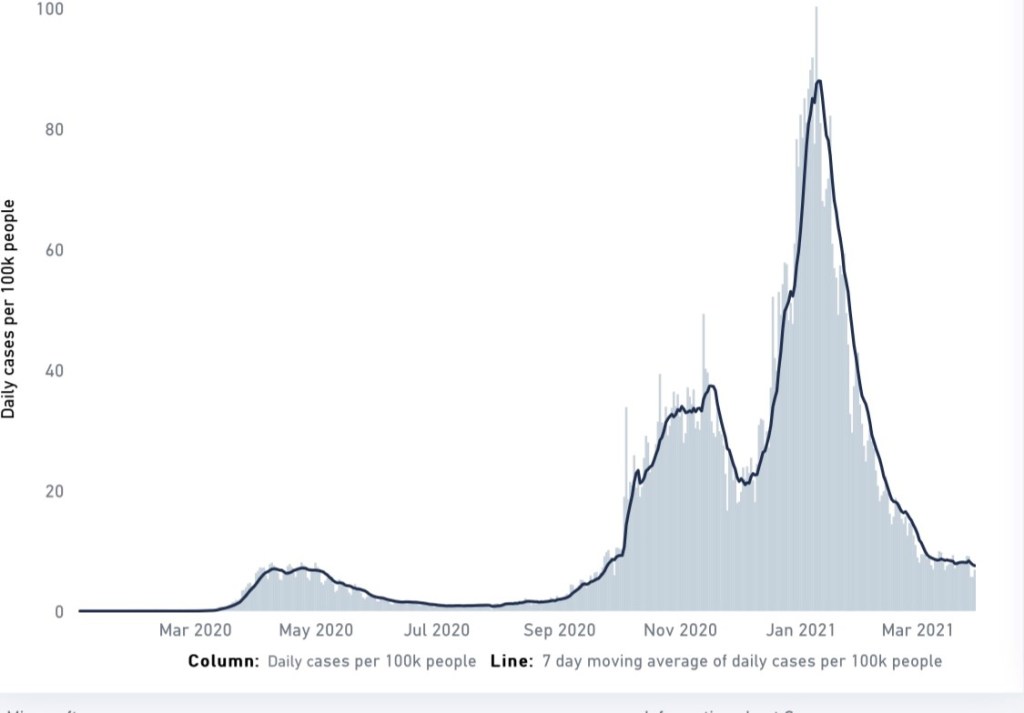
  1. Let’s start off with looking at the epi curve for the US (see below).

To understand what I mean by a fourth surge, look at the graph. The first surge began on March 12, 2020. The peak of the first surge came on April 9, 2020 with a 7-day moving average of daily new cases of 9.9 per 100,000 population.

Let’s take a moment to give perspective on what these numbers of new cases mean with respect to the degree of disease transmission. People often ask me when we will achieve herd immunity. I don’t know, other than I know it is not going to be April as a well-known physician author wrote recently (see my prior blog piece for an explanation as to why that is completely unrealistic.) However, I am pretty sure we won’t get there in 2021. While everyone wants to know the percentage of the population that has to have immunity to achieve herd immunity (and no one knows the answer to that), I tell them one way to know when we get there is to look at the 7-day moving average of daily new cases. It should be <1 daily new cases per 100k and remain that low for months. We are nowhere near that.

Community spread is when the level of disease transmission in a community is such that we no longer can identify the source of infection. Early on in the pandemic, there was a period of time that we could identify an exposure from travel or an infected person. When we get to the levels of disease transmission associated with community spread, we no longer can reliably pinpoint sources of infection. Using the metric of the 7-day moving average of daily new cases, community spread is 1 – 9 daily new cases per 100k population. So, you can see that at the peak of the first surge, we were at the highest level of community spread.

When the 7-day moving average of daily new cases per 100,000 is in the range of 10 -24, we refer to that as accelerated community spread and when > 25, we refer to that as the tipping point – generally the point where public health experts would call for serious mitigation measures, e.g., stay-at-home orders, closure of certain businesses, etc.

Now, notice something concerning from the epi curve above. We never came down to that well-controlled level of disease transmission of < 1. The lowest point following the first surge occurred on May 28, 2020 when the 7-day moving average of daily new cases per 100,000 was 6.5 – community spread.

We began the second surge from this elevated level of disease transmission. In other words, we loosened up our restrictions too soon. If you recall, people were celebrating the cases coming down, began getting together in larger groups without masks, believing the worst was over, and surely as we moved into the beginning of summer, the virus would go away, though many of us were warning that there was no evidence that there would be seasonality to this virus, and even if there was, it likely would be back in the fall with a vengeance.

So, the second surge was under way at the end of May/beginning of June and peaked July 22, 2020 at a level of 20.3. Notice that this second surge was higher than the first, and like the first, we again did not come down to levels of disease transmission that were under control before we began the third surge. In fact, the lowest point after the second surge was on September 12, 2020 when the 7-day moving average of daily new cases per 100,000 was 10.3. Note that this low point was higher than the low point following the first surge and represented accelerated community spread.

Having this springboard of accelerated community spread resulted in an even higher third surge that peaked January 8, 2021 with an unbelievably high disease transmission rate reflected by a 7-day moving average of daily new cases of 78.3 per 100,000.

Once again, as happened with each of the two prior surges, cases came down from the peak, and I began hearing the all-to-common refrain by now that things were returning to normal (how soon people forget), but coupled by the even more concerning actions by elected leaders across the country to loosen and often terminate all public health measures in place to contain the spread of the virus.

But, while others saw reason to cheer, I became alarmed in the third week of February when I saw the sharp decline begin to plateau, and like the first two surges, at way too high a level of disease transmission – the lower range of accelerated community spread and the higher end of the range for community spread. I had already seen this movie twice and I knew how it turns out.

  • So, now let’s look at Idaho’s epi curve:

Idaho, too has experienced three surges, but there are a few differences. Our first case was on March 13 and our first surge peaked on April 4, 2020 at 6.5 average daily new cases per 100,000. But by May 13, we were down to average daily new cases of only 1.3, almost at the containment level. The difference from the US disease transmission was, due to the brave actions of our governor, we had a stay-at-home order in place and it worked. Recall that the U.S. was almost 6 times higher than this level of disease transmission. We know that the governor’s actions saved lives.

Our second surge took off in the middle of June and hit a peak on July 19 at a level of daily new cases of 31.9 per 100,000, higher than the U.S. peak for the second surge. Unfortunately, our low point after the second surge was only 13.4 on September 13. This time, without the stay-at-home order and with COVID-fatigue already setting in, like the rest of the country, Idahoans began relaxing their compliance with public health measures too soon.

Our third surge would begin almost immediately and peaked on December 10 with a 7-day moving average of daily new cases of 91.7 per 100,000. Although cases declined significantly after hitting this peak, as they had in every prior surge, again, I became concerned in mid-February when our state cases hit a plateau and remained in the community spread range, even while many were celebrating a return to normal and our elected leaders were saying all kinds of ridiculous things, like this did not even qualify as a pandemic and there was no longer any need to wear masks, physically distance or restrict the size of gatherings. Of course, in an interesting twist of karma, the legislature then found itself with an outbreak of COVID in the Capitol and as a result had to interrupt the session to recess in order to stop the spread of infection among lawmakers and their staff members — a reminder that we can deny COVID, we can spread lies about it, we can create alternative facts, we can find some doctor out there to tell us what we want to hear that has already been debunked by the medical community, and we can embrace conspiracy theories, but that merely plays into the virus’ hands resulting in many needless infections, as science will always prevail in the end.

While the U.S. and Idaho epi curves explain why I was concerned about a possible fourth surge by mid-to-late February, why was I concerned even before then that we would experience a fourth wave?

There have been two times during the pandemic that we could get a preview of coming attractions. The first was at the beginning of the pandemic in January of 2020 when we could look at the outbreak in Wuhan to see what we might eventually be dealing with in the U.S. – cases of pneumonia that seemed to disproportionately land older people in the hospital. The second time has been since December 2020 in Europe, particularly the U.K., as the B.1.1.7 (Kent) variant quickly evolved over the course of just two to three months to become the dominant strain in the U.S. causing an increase in cases in all age groups and a new surge that was far greater than anything the U.K. previously experienced and was really a surge upon a surge. Let’s look at the U.K. epi curve:

The first surge in the UK peaked on April 24, 2020 at a 7-day moving average of daily new cases of 7.1 per 100,000. But, unlike the U.S., the U.K. successfully brought their disease transmission down to below 1 by July 4, 2020 and it remained low for weeks.

By August 6, 2020, cases began to very slowly rise. Then a sharp rise in cases began at the very beginning of October. At the end of October, the U.K. implemented a lockdown, but allowed schools to remain open. Cases peaked on November 16 at a 7-day moving average of daily new cases of 37.3 per 100,000. By December 4, 2020, cases had come down to a low point of 21. Keep in mind, this level is still in the accelerated community spread level of disease transmission.

But something else was happening under the radar. A new variant had emerged in the U.K. just outside of London in the village of Kent in October. This variant came to be known as B.1.1.7. We saw that it only took 2 – 3 months for B.1.1.7 to become the dominant circulating form of the virus in the U.K. While cases were declining from U.K.’s second surge, the proportion of isolates from people infected that were B.1.1.7 were increasing. What happened next? A new, much larger spike in cases began reaching a new peak on January 10, 2021 with a 7-day moving average of daily new cases of 87.9 per 100,000, despite a lockdown in November and a new lockdown in January. The difference? One difference was that the cases in this most recent, higher spike were mostly B.1.1.7. Another difference was that during the November lockdown, schools were kept open.

The U.K. had previously had the same experience with schools that we had in the U.S. Before the variants, we saw few infections in kids and little spread within schools. So, the U.K. locked down essentially everything but schools at the end of October. However, it soon appeared that the transmission characteristics of B.1.1.7 were different than those of the variant we have dealt with around the world for much of the last year. The U.K. started seeing more infections in children and more outbreaks in schools and daycare. And, lest people think that this was something unique to the Brits, we were also beginning to see the same thing happen in Italy, Germany and Denmark where B.1.1.7 was growing in the percentage of isolates causing infection. Then an interesting fact emerged from the data. While B.1.1.7 tended to increase infections in all age groups, the age group with the highest increase in secondary attack rates (i.e., rates of infection of others who are infected) was 30 – 39-year-olds. Why would that be? In the U.K., adults of that age range should mostly be working from home due to the lockdown. My speculation was that this is likely the age of the parents of children in school. In other words, my concern was that they are having in-school transmission among children, many of those infections might have been mild or asymptomatic and not detected, yet the children were going home from school and infecting their parents.

Obviously, at the beginning of February, we still didn’t have all the answers, but this was enough for me to sound the alarm with our local school districts, but one that fell on deaf ears. As one board member told me as I pleaded with the board not to make a decision in February to bring all children back at the end of March when we knew the best physical distancing we could achieve in schools with students in the hybrid model was 4.5 feet and when I assured them that we would know much more about the variants and how vaccinations were going in Idaho by the end of March: “we don’t care about what might happen then, we are just looking at what is happening today.” I was shocked.

Further myopic was the board and administration’s assessment that things would be fine because children seldom get serious illness and by the end of March, teachers would have had an opportunity to be vaccinated. I tried to point out that students and teachers are not the concern based on what we were seeing in Europe. It is the parents in their 30s and 40s who were not expected to be vaccinated in Idaho by the time they were bringing all students back just as the CDC was predicting that B.1.1.7 would be the dominant circulating form of the virus in the U.S. This didn’t seem to influence them in the least, I presume because they assume that 30- and 40-year-olds don’t get seriously ill. Again, I tried to explain that studies were coming back suggesting that B.1.1.7 was 40 – 70 percent more transmissible and early reports out of the U.K. were that this variant caused more severe illness. I also tried to point out that there are many parents in this age range who have serious underlying health conditions that place them at increased risk, and there are many who are taking chemotherapy for cancer, have immune deficiencies or are taking immunosuppressive medications and may not do well if they become infected with a more transmissible and virulent form of virus. I also tried to point out that some students, especially those in socioeconomically disadvantaged situations may be living in multi-generational households with older family members who may not be vaccinated, and will be at very high risk due to age and potentially underlying medical conditions. It was if I was talking to myself.

By this time, it was not only the UK, but Italy, Germany, and Denmark that would give the world warnings that B.1.1.7 transmission characteristics were different. While children did not seem to get sick as often as adults and did not seem to spread infection within schools or contribute to community spread prior to the rise in B.1.1.7, the countries and others were now indicating that there seemed to be significant spread in schools that was contributing to community spread and these countries were now closing schools. They warned the world that B.1.1.7 is more transmissible, causes more severe disease and that it is much more difficult to contain its spread. The U.K. warned that maintaining physical distance was the only hope to controlling the spread of this variant.

So, for all these reasons, I was very concerned that this was exactly what would happen in the U.S. Why would we be different? Some dismissed my concerns believing that what happens in Europe has no bearing on what will happen in the U.S., let along Idaho. Then it started happening in Canada. That still did not persuade people. But, recently, it started happening in the U.S. While I had hoped that I was wrong and overreacting, all the evidence kept affirming my fears. So, let’s look at a few examples of this additional evidence.

  1. Outbreak of B.1.1.7 infections in Minnesota in late January into February 2021. From the Minnesota Department of Health – Since late January, at least 84 cases of COVID-19 have been linked to participants in both school-sponsored and club sports activities, including hockey, wrestling, basketball, alpine skiing, and other sports. In addition, health officials have seen increases in cases in Carver County gyms and fitness centers, with many of the cases linked to the sports-related cases. The Minnesota Department of Health (MDH) has observed a concerning increase in the rate of growth of cases in Carver County over the past month (a 62% increase between the week beginning Jan. 27 to the week beginning Feb. 24). Case rates in Carver County are now approaching rates seen in October 2020, and a high proportion (35%) are under age 20.

“We are increasingly concerned about dramatic increases in cases, particularly in Carver County where the B117 variant has been confirmed.”

Through recently completed whole genome sequencing of a portion of the sample specimens from the outbreak cases, health officials confirmed 27 cases of the B117 variant, a highly contagious and potentially more virulent variant first identified in the United Kingdom. Cases have occurred in athletes, coaches, students, and household contacts. Multiple schools, both public and private, have confirmed cases tied to the variant strain cases. Many of the people with B117 variant COVID-19 attended school or sports activities while infectious. The concern is this highly contagious variant has the potential to spread exponentially and quickly across youth who are largely unprotected by vaccines.

  • In one week in early March, Duke University had an outbreak of COVID cases among students. The number of new cases in that one week exceeded the total number of cases that occurred during the entire Fall semester.
  • We have seen a large outbreak of new COVID cases in Eastern Idaho. Looking at just one of the involved counties, Bonneville, the peak occurred on March 14 and reached a 7-day rolling average of daily new cases of 72.8 per 100,000.
  • Although we do not do enough sequencing in the United States or in Idaho to know what percent of cases are currently caused by B.1.1.7, we do know that B.1.1.7 is significantly increasing and has become the most frequently identified variant of concern in samples that are sequenced. European countries have warned that once B.1.1.7 surpasses accounting for half of the circulating virus, we can expect a soon upcoming surge.
  • The testing positivity rate in Idaho had fallen to 4.5% by the third week of February, but has increased to 5.5% by mid-March.
  • What is happening now?
  1. New cases in the U.S. are up 20% from the prior two weeks.
    1. Cases are in the accelerated community spread category, increasing and staying high in 28 states plus the Virgin Islands and Washington D.C.
    1. Deaths are increasing in 8 states plus Washington D.C.

I could keep on going with examples, but let’s look at one more local indicator that I find fascinating.

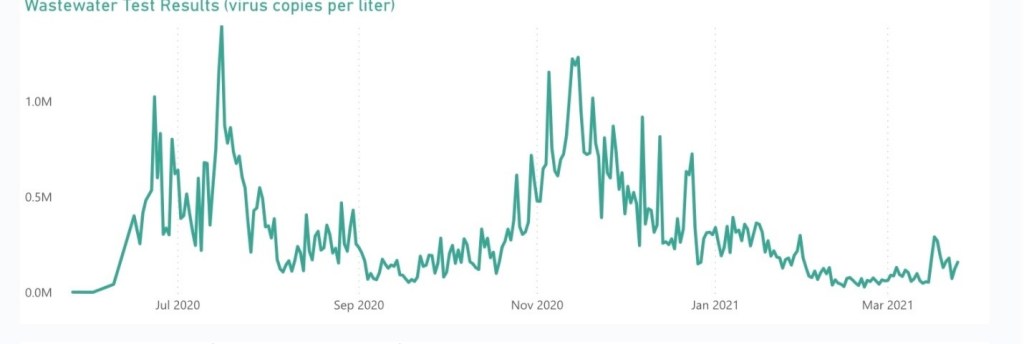
This is the wastewater testing for SARS-CoV-2 virus done by the City of Boise. It shows that we got to a low on February 14 of about 33,000 virus copies per liter, but it has been increasing since then, signifying more virus (i.e., more infections). By March 17 it had peaked at about 293,000 virus copies per liter. As of the last date of data available (March 25) the count was about 160,500, i.e., almost a 5-fold increase in viral levels from the low just the month before.

So, I will stop here and address some of the counter-arguments. But, hopefully you can get a sense of why I have been predicting this upcoming 4th surge.

Arguments:

  1. The vaccine roll-out will stem this surge. My response – I hope so, but don’t think so. We simply do not have enough people vaccinated to get us anywhere near herd immunity. For more on this, see my prior blog piece.
  2. We don’t have to worry about Boise or West Ada schools because the CDC said we can operate schools safely with only 3 feet of distancing. Response – Wrong. The CDC has indicated that 3 feet of distancing is not recommended for schools in communities with the highest levels of disease transmission (which is what the CDC considers Ada County to be in) and the CDC indicated that in all cases there should always be at least 6 feet of distancing when students have masks off (for example, the cafeteria), but in all the schools I inspected, I never found a school that could get more than 4.5 feet of distancing in the cafeteria with only half the students in attendance.
  3. We have been able to prevent transmission among health care workers in hospitals where they often work less than 3 feet apart. Response – Two big differences. First, the majority of health care workers have been vaccinated. Almost no children have been vaccinated. Second, this was the experience with the wild-type virus, not B.1.1.7. In fact, one of the Duke hospitals just reported an outbreak of COVID cases on a cancer unit involving 20 staff and patients.
  4. We don’t have to be concerned because it has warmed up and everyone will be outside and so we won’t have much spread of the virus. Response – (1) There is absolutely no evidence of seasonality of this virus. (2) Why do you think that will be the case this year when it wasn’t last year? Note from the epi curves for the US and Idaho above that the surges in the summer were far greater than the first surges in March/April of last year. People don’t spend all day, every day during the warmer months outside. In fact, in many places in the country, the heat and humidity cause people to move indoors during the middle of the day for air conditioning.

Well, we will know soon enough who is correct. I pray that I am wrong, but as I review the activity around the world and in the U.S. and even here in Idaho, I only become more and more convinced that I am right. We will know soon enough.

No, We will not have Herd Immunity by April

Dr. Marty Makary is a brilliant physician and communicator. I am a fan. However, he just wrote an Opinion piece for the Wall Street Journal entitled, “We’ll Have Herd Immunity by April.” He could not be more mistaken.

He points to the significant decline in cases, his projection that 55 percent of Americans have natural immunity from past infection and an assertion that 15 percent of Americans have been vaccinated.

So, let’s understand why we are nowhere near herd immunity:

  1. Yes, cases are down. They are down following an all-time high surge that just two months ago was threatening to overwhelm our health care system. Cases always come down after a surge, and holidays are notorious for creating surges in cases due to travel and extended families and friends getting together.

So, are the cases down at a level that would suggest the pandemic is coming under control? No. Our current 7-day moving average of daily new cases per 100,000 in the U.S. is at 23.9. We have had 3 spikes or waves in the U.S. of cases. Our first was in March of 2020 at the onset of the pandemic. You might recall that cases were so alarming back then that many states implemented stay-at-home orders or lockdowns. So, what was the 7-day moving average of daily new cases per 100,000 in the U.S. at the peak of that first spike or wave? 9.8.

Our second spike or wave of cases was far greater and occurred during the summer. Well, what about the second spike or wave? What was the 7-day moving average of daily new cases per 100,000 in the U.S. at the peak of that wave? 20.4.

As you can see, cases have not even come down to the highest point they previously were with our first two waves. So, it seems premature to be declaring victory. We have all become a bit numbed to the numbers. We are currently at levels of disease transmission that last year would have been quite alarming. But, with each higher wave of cases, hospitalizations and deaths, we have become so conditioned to the large numbers that we think when cases are coming down from an all-time high that we must be on the home stretch.

So, how do we put these numbers in perspective? The Harvard Global Initiative sets 25 daily new cases per 100,000 as the level at which lockdowns, stay-at-home orders, etc. are indicated. Remember the White House Coronavirus Task Force chaired by Vice President Pence? The number they used for when transmission was out of control and required significant restrictions – 14. So, I think Dr. Makary is painting a far rosier picture of where we are than what the data shows.

Here’s additional perspective. Remember back at the beginning of the pandemic when our objective was to avoid community spread? Community spread was when there was so much spread within a community that we could no longer identify the source of infection for people who tested positive for COVID. Translated into daily new cases per 100,000, community spread is 1 – 9. Over 9 is accelerated community spread. That is where the U.S. is now.

So, if we were to get to herd immunity, what level of daily new cases per 100,000 would that be? Answer – less than 1. As you can see, we are nowhere close to this.

  • Dr. Makary projects that 55 percent of the American population has been infected. The problem is there is no way to prove or disprove that assertion. No serologic survey in the U.S. would lead us to that conclusion. Dr. Makary rightly points out that people may have immunity even without measurable antibodies due to T-cell mediated immunity. This is true, but again, doesn’t help us get to the number of people who have immunity, because we cannot routinely test for T-cell mediated immunity.

The CDC has made its own projections about how many Americans have been infected (and then presumably are immune, however, we are not inclined to believe that everyone who has been infected does have persistent immunity). Their projection is 83,111,629. Using the most recent U.S. population number, that would mean 25 percent of Americans have been previously infected and might still be immune – less than half of what Dr. Makary projects. We can’t know who is right.

But Dr. Makary goes on to make a statement that we know is incorrect. He states, “Herd immunity has been well-demonstrated in the Brazilian city of Manaus, where researchers … reported the prevalence of prior COVID-19 infections to be 76%, resulting in a significant slowing of the infection.” You may recall that Brazil did have a massive explosion of COVID cases at the beginning of the pandemic in the spring of 2020. Manaus was hit particularly hard. In less than 10 days, the health care system in Manaus was overwhelmed. Patients were turned away from hospitals bursting at the seams with COVID patients. Many who died of COVID were placed in mass graves.

Mathematical projections of the numbers of people who would have to be immune in a population (a herd) to make it difficult for the virus to circulate in the herd and infect those few who are vulnerable was 60 percent and virologists and our own public health experts anticipated that the actual threshold for herd immunity might be 60 – 70 percent. When scientists determined that 76% of the population of Manaus had been infected, the highest prevalence of any place in the world that I am aware of, it is true that we certainly presumed that Manaus likely had achieved the level of infection necessary to achieve herd immunity. But, where Dr. Makary is mistaken is his assertion that herd immunity was “well-documented in the Brazilian city of Manaus.” In fact, subsequent events disproved herd immunity in Manaus.

Recently, Manaus went through a new surge in COVID cases overwhelming their hospitals, not in 10 days as previously, but now in 24 hours. This is a strong argument against herd immunity. Hospitals quickly ran out of oxygen. Some hospitalized patients died because there was no supplemental oxygen to administer. Many more people died at home due to the lack of hospital capacity. This second wave was greater than the first. This is not consistent with herd immunity.

Now, one could argue that perhaps Manaus had reached herd immunity, but people’s immunity from previous infection with prior variants had waned, and they no longer maintained herd immunity. True, that may be the case. However, if true, that should also cause us concern in the U.S. that not all the people Dr. Makary believes have previously been infected remain immune. One could also argue, well the people of Manaus probably developed herd immunity to the D614 or D614G variants that were common at the time, but they just were not immune to the new variant, P.1. Also, very possibly true. But, in either case, what good is herd immunity, then? In the U.S., we have at least four new variants of concern (more variants than that, but I am just referring to the variants that have us worried). And, in either case, then why should Dr. Makary convince us that the U.S. will achieve herd immunity by April and all will be fine?

  • Dr. Makary asserts that 15% of Americans have been vaccinated. However, based on the latest numbers reported by the CDC, only 5% of the American population has been fully vaccinated, and with the most generous interpretation of the percentage of Americans “vaccinated” to include those who have only received their first dose, it would be 12.7%.

I am sorry to tell you that I don’t perceive any situation by which the United States achieves herd immunity by April of this year. The previous mathematical projection of 60 – 70% of people needing to be immune in order to achieve herd immunity has been revised upwards to perhaps 85% because models predict that a far more contagious variant will become dominant in the United States in March. In calculating the percentage of population necessary to achieve herd immunity, everyone who can be infected and transmit the disease must be included in the denominator. It is estimated that 24% of the American population is under the age of 18. There currently is no approved vaccine for children under the age of 16 and it is unlikely there will be until at least summer. If the percent of the population under 16 is 20%, then already, if everyone else in the country over the age of 16 has been infected and/or received a COVID vaccination, we would only get to 80% immunity. But, then again, we know that surveys tell us something on the order of 30% of Americans are either vaccine-hesitant – they want to wait 6-12 months before they get vaccinated or they are telling us that they will not get vaccinated.

Let’s march on. We will get there; we just won’t get there by April. Please don’t let your guard down. Stay home if you are sick. Get vaccinated if and when you can. Avoid gatherings of people other than those you live with, particularly indoors. Wear a mask when you are around people you do not live with. Wash or sanitize your hands often and every time after touching surfaces that are in public spaces. Keep a physical distance from others of at least 6 feet.

I haven’t posted many blog pieces lately, and that is because I am writing a book. But, I worry that you are hearing and reading a lot of false or misleading information right now, so I am going to try to write more often. As the co-author of the book we are working on often says, “Stay positive and test negative!”

Commonly Asked Questions about the New (Pfizer) COVID Vaccine

Should I get the vaccine?

For most people, the answer is yes. For this first vaccine, you will have to be at least 16 years of age. Those who have had severe allergic reactions (e.g., anaphylaxis) to any components of this vaccine in the past will not be eligible to receive the vaccine. We don’t yet have enough data to know whether the vaccine is safe for pregnant or lactating mothers.

When will we be able to vaccinate young children?

We don’t know yet, though I would anticipate that we may be able to do so sometime between the end of this school year and before the start of the next.

How many shots do I have to get?

Two shots separated 21 days apart.

How long until I have to get the next set of shots?

We don’t know yet, but we are anticipating that it may be as soon as a year or as long as three years. We will know better before you will be due for next year’s shots if it is a year.

Is the vaccine safe?

Yes, no serious safety concerns have been identified in the clinical trials thus far. With that said, side effects with vaccines are common, and often are evidence of the body mounting the desired strong immune response we are seeking. The most commonly reported side effects were pain at the injection site, fatigue, headache, muscle aches, chills, joint pain and fever.  These side effects are generally short-lived and typically resolve within several days of receiving the vaccine. These side effects tend to be very mild with the first shot and more severe with the second. Interestingly, older recipients of the vaccine tended to have milder symptoms with both shots.

How effective is the vaccine?

The vaccine is highly effective appearing to prevent COVID in 95 percent of those vaccinated, and in those few who still got infected despite getting the vaccine, they appeared to have significant protection against getting severe disease that would result in hospitalization or death.

When can I get the vaccine?

Because of demand and the fact that the vaccine is being manufactured and distributed, each state will get their vaccine in allotments every month, with the first shipments being received in mid-December. People will be divided up into priority groups that will determine when you will be eligible for vaccination. The first priority group is health care workers and residents of long-term care facilities. They will be able to be vaccinated starting this month. We don’t know the schedule for when additional groups will be eligible to receive the vaccine, but we would expect that high risk individuals may be able to be vaccinated as soon as February and the general population perhaps as early as April. However, watch your local news for public service announcements as to when it is time for you to be vaccinated.

Where will I go to get vaccinated?

Your primary care provider, local hospital and local pharmacy may be offering the vaccine. Information as to vaccination sites will be made available before the time you become eligible.

Is there a cost for the vaccine?

The vaccine is free, though there may be an administration fee charged by the provider. Be sure to check ahead of your appointment for vaccination whether you will need to pay anything at your visit or whether they will bill your insurance.

Once I get the vaccine, do I still have to wear a mask? Yes, we will all have to continue following all of the public health advice about staying home when we are sick, washing or sanitizing our hands frequently, covering our coughs and sneezes, keeping a distance of at least six feet from others with whom we do not live, and wearing masks anytime we are outdoors and cannot maintain the six feet of separation from others or indoors anytime we are with individuals who are not part of our household regardless of distance until a sufficient number of Idahoans and Americans have been vaccinated for us to achieve herd immunity (likely next fall). It is not yet known whether people who are vaccinated and are exposed to the SARS-CoV-2 virus might be able to transmit that virus to others even though they themselves are protected from infection so these infection control measures remain important for now.

How to Have a Virtual Thanksgiving

As we approach the Thanksgiving holiday, people long to get together with extended family, and surveys indicate that more than half of all Americans plan to travel for this Thanksgiving. However, we are also seeing record numbers of COVID cases, hospitalizations and deaths.

Given this uncontrolled disease transmission throughout most of the United States, the beginning of influenza season, and the fact that extended family get togethers are one of the most common transmission events for COVID, the CDC and many public health experts have strongly advised people against travel and spending Thanksgiving with those with whom you do not live. Canada had their Thanksgiving in October and experienced significant transmission of COVID within extended families. I have no reason to believe we will not have the same experience in the United States.

So, if you want to protect yourself and your family, let me suggest a virtual Thanksgiving. Given that gatherings are one of the riskiest settings for disease transmission, I reached out to an event planner to find out how they were helping clients do virtual events. I didn’t have to look far. My daughter, Lindsey Pate is a professional event planner with Bliss Events here in Boise. She has helped clients create virtual birthday parties and other events, so I asked her for her advice as to how people who want to spend time with family for Thanksgiving could do so safely and virtually. Lindsey is also a certified nursing assistant, who has participated in the care of COVID patients at a medical center here in Boise, so she is acutely aware of how severe this disease can be. Here was her advice:

Celebrating Thanksgiving From a Distance

By Lindsey Pate

Since you are following my father’s blog, I’ll wager we’re cohorts in understanding this virus is real and our behaviors are a contributing factor in the control of its spread. With the holidays approaching, those of us with a similar mindset may be considering how we can honor the season through responsible, festive celebration. As a professional event planner and a healthcare worker, I have been pivoting since March to work with clients and my own family on how to celebrate while avoiding unnecessary exposure.

By now, we know the short list of guiding principles until a vaccine is readily available– distance socially, wash our hands, avoid touching our faces, and if gathering, do so outside, in well-ventilated areas– but what does this mean for holidays centered around gathering and togetherness? Here’s a short list of ideas to acknowledge the holiday and inspire feelings of closeness, while adhering to the distancing recommendations of medical experts.

Together at a distance:

Most families I know will choose to join as a household to celebrate the Thanksgiving meal tradition. To keep the sense of celebration intact, consider plans to meet with extended family afterward, in a socially distanced setting. Just as Covid birthdays saw the rise of drive by parades, the same idea can be applied for the holidays: decorate your vehicles and plan a caravan for immuno-compromised or elderly relatives. If you’re ready to usher in the Santa season, pre-purchase tickets for an event such as Idaho Botanical Garden’s Winter Garden aGlow; the venue will be implementing social distancing and safety protocols to alleviate precaution pressure.

Going virtual doesn’t have to be awkward:

The year has taught us the ins and outs of the proverbial Zoom meeting and it’s likely some of us are planning an online dinner session. Avoid the silent pauses and over-talking with some pre-planned activities. Activities like a costume contest (can ugly Thanksgiving sweaters please be a thing?), turkey themed “Minute to Win It” contests, even a household scavenger hunt can be fun to break up the lulls. Gift bags can be porch-delivered ahead of time and include conversation starters (pieces of paper with topics to encourage discussion), game activities, and even slices of Mom’s pumpkin pie to enjoy simultaneously. Appoint a moderator (kids love this role!) to facilitate a talking order and award speaking privileges when multiple relatives pipe in at once.

Remember, it’s about reflection and gratitude:

So, gratitude pumpkins are a thing and they’re pretty great. Buy pumpkins for every person within a family unit and write a name on each gourd (or squash… fruit?). This can be a real pumpkin, but I also love the foam pumpkins that can be kept forever. If you’re a large family, consider a Secret Turkey and draw names ahead of time for the family with which you will share your admiration. Use an indelible pen to write directly onto the pumpkin the things you love and are thankful for about this individual, then deliver to their respective doorsteps. Let the comments be positive and anonymous – you may be wonderfully surprised by what others appreciate about you! If not everyone is interested in a little leg-work, have someone create a slide show of family photos to be shared digitally or virtually.

Ditch the cooking:

There’s nothing typical about 2020, so why not turn the whole thing on its head? Skip the cooking this year and dine at home with food created by a talented, local chef whose business could use your support. For more traditional continuity, have every household in your family place an order and eat together virtually, while sharing the same meal.

Go for it:

As gatherings dwindle to ten or fewer, the opportunity arises to create that spectacular, Pinterest-worthy event you’ve always wanted to host! Throughout the pandemic, we event planners have seen attention paid to the smallest of details, since the guest counts are manageable and budget friendly. For your family, maybe this means breaking out Grandma’s special dishware and linen napkins, or creating place cards and a beautiful centerpiece, or cooking your green bean casserole because it’s delicious and Aunt Sally always volunteers to bring hers first! Whatever this looks like for you and yours, 2020 is the year to simply go for it.

However you choose to celebrate next week, Thanksgiving still remains a day worth dedicating to gratitude and reflecting on the year’s blessings. Beyond the fact we are all grateful this year is approaching its conclusion, enjoy the special time with your loved ones and make the most of the lemons we’ve been stockpiling since Spring.

From our family to yours, we wish you a very Happy Thanksgiving and a beautiful holiday season.

School Operational Plans

Some of you are aware that I am helping some schools with their pandemic operational plans. In my work with one school district, it became clear that we needed to rewrite their operational plan. We have taken a unique approach to this plan. First of all, most plans are written for school leaders, staff and teachers. But, if we are going to be successful, we need to have the help of parents. So, this is the first plan that I have ever seen that also includes parents and their role in the pandemic operations. Further, plans that I have seen tell people what to do, but I have never seen a plan that explains why. It is my view that if we want people to do things that are above and beyond their normal duties/responsibilities, we have to explain why. So, I thought that an excerpt from the plan might be helpful to everyone, whether you are a principal, teacher, or parent. So, here you go:

  1. What is SARS-CoV-2 and how is it transmitted?

The Severe Acute Respiratory Syndrome – Coronavirus 2 (SARS-CoV-2) is the name of the virus that causes COVID (coronavirus disease) or COVID-19 (the 19 refers to the fact that this disease was first recognized in 2019).

The SARS-CoV-2 virus is very contagious and the challenging thing for managing the spread of this virus is that people often are contagious in the day or two before they develop symptoms, and others are infectious though they may remain asymptomatic for the entire duration of their infection. Therefore, until the spread of this disease can be brought under control, children will show up for school infected and contagious even though there may be no sign that these children are ill. The safest thing is to assume that you may be contagious and should therefore avoid close contact (six feet) with persons with whom you do not live and that everyone else apart from those with whom you live that you interact with during the day are potentially contagious.

The virus is transmitted in three different ways:

  1. Droplets – This is the most common way the virus is transmitted. Droplets refer to the secretions that come out of our nose or mouth when we speak, cough, sneeze, yell or sing, and if you are infected, virus will be contained in these droplets. This is why it is important to COVER YOUR COUGHS AND SNEEZES. No doubt you have noticed at times when talking or when observing someone else talking, that you can see small amounts of what you may have called spittle or spit come out of the mouth while speaking. This is normal and common, in fact, it is happening even when you don’t notice it.

We call this spittle or spit droplets, and these are secretions from your nose mixed with mucous or your throat mixed with saliva. If someone is infected with the SARS-CoV-2 virus, this virus resides for a period of time in the nose and throat and therefore is likely to be present in those droplets.

As droplets come out of our mouth and nose, they travel for a distance and either land on a surface or fall to the ground. If you are sitting at a desk, some of these droplets will land on your desk. If you are working on a computer, droplets will land on the screen and the keyboard. If you are talking on an iPhone, droplets will collect on the screen. This is why we must WASH OR SANITIZE OUR HANDS FREQUENTLY and CLEAN SURFACES that are touched or in close proximity to teachers and students AT LEAST DAILY AND ESPECIALLY BETWEEN USE by different teachers or students.

The droplets travel various distances, depending on their size, weight, the humidity in the room or outside, and what barriers are in their way (like a laptop computer or another person). The largest number of droplets will be in the air and in surfaces close to the person who is talking, coughing, sneezing, or singing, generally falling to the ground or evaporating by a distance of six feet. This is why we ask that everyone try to MAINTAIN A DISTANCE OF SIX FEET BETWEEN YOURSELF AND ANYONE YOU DO NOT LIVE WITH. This includes walking to school, riding the bus, arriving at school, in the hallways, in your classroom, at recess, while you are eating, and when you are in PE class or playing sports.

When a person is close enough (within six feet) to another person who is infected, and may not even realize that they are infected, then these droplets can land on the other person’s face, eyes, nose or throat and the virus in the droplets can infect that person by the person touching their face and then introducing it into their eyes (by rubbing their eyes), their nose (by rubbing or picking their nose or by simply breathing the droplets in) or their mouth (by the droplets landing in the mouth or by droplets on the lips being introduced into the mouth with licking their lips or with eating or drinking).

DISTANCE IS OUR MOST EFFECTIVE WAY TO SLOW DOWN AND PREVENT THE SPREAD OF THIS DISEASE. This is why we ask everyone, whether in school or at night or on the weekends, please avoid large gatherings. Large gatherings increase the likelihood that someone in that gathering is infected and contagious, even if they feel perfectly well and appear well, and large gatherings make it difficult to maintain your distance of six feet at all times.

Along with keeping our distance, the other most important thing we can do is to WEAR PROPER FACE COVERINGS PROPERLY. The main thing face coverings do is serve as a barrier to collect the majority of these droplets, and by doing so, blocking virus in those droplets from getting onto someone else’s face, eyes, nose or mouth that could then infect that person.

One can still be infected by droplets outdoors, though air and wind currents tend to impede the distance droplets will travel outside. Nevertheless, when outdoors, we should continue to KEEP A DISTANCE OF SIX FEET FROM ONE ANOTHER and WEAR PROPER FACE COVERINGS PROPERLY when there is a risk that distancing cannot be maintained at all times.

  • Airborne or aerosols – This is the next most common way to transmit the virus and likely the cause of transmission when you hear about “super-spreader events.” Aerosols are smaller than droplets. If you think of droplets like spittle, think of aerosols like the mist of hair spray or deodorant spray, although these can be even smaller. It may be confusing to call this airborne transmission when we talk about droplets, above, that also travel in the air. The difference is that droplets travel in the air only as far as they are expelled with force. For example, droplets will travel a shorter distance when we are speaking softly than they will when the teacher is projecting her voice in the classroom so her students can hear or when a coach is yelling or cheerleaders are cheering. Similarly, coughing or sneezing expels droplets a further, but still limited, distance.

To better understand airborne transmission, think of a time you were entering a room after someone was smoking or even when you were outside walking behind someone who was smoking. Could you smell the cigarette or cigar? Or, recall a time when you entered the locker room after people were exercising and sweating. You were smelling odors that were not projected into air by droplets, but rather carried in the air streams in the room or outdoors. That odor could just as well be virus particles carried in aerosols. And, if you were breathing in those odors and able to identify the smell, you would also be breathing in virus particles if they were circulating in aerosols.

Droplets travel a finite distance, in most cases, little more than six feet due to being pulled down to the ground by gravity or evaporating in air. In airborne transmission, the aerosols are small enough and light enough to travel on air streams, generally those created by indoor ventilation systems. They can travel the entire distance of a room or open area on these airstreams as they move to wherever the air return is.

“Super-spreader events,” namely those events where numerous persons are infected by a single person, tend to be large gatherings held indoors. While some people in attendance in close proximity to others may be infected by droplets, it is likely that many are infected by these aerosols traveling on air streams. These aerosols are created the same way that droplets are, but appear to be produced in larger amounts and with higher amounts of virus in them when people raise their voice, yell, cheer, or sing.

There are ways to mitigate the risks of airborne transmission:

  1. If weather allows classes or other activities to be held OUTSIDE, the risk of airborne transmission is reduced greatly.
  2. WEARING A PROPER FACE COVERING PROPERLY has been shown to reduce the number of aerosols a person emits into the air by 65 percent, because these, too, can be blocked to some extent by a face covering.
  3. COVER YOUR COUGHS AND SNEEZES to reduce the number of aerosols ejected out into the air.
  4. If indoors, increase the number of air exchanges per hour. Four to five air exchanges per hour would be good. The higher, the better. In addition, air in school buildings should not be recirculated when possible. It is always best to exhaust the air to the outdoors and circulate fresh air.
  5. If indoors, look for the air return in the room. Because air streams move towards the air return. Make sure that the teacher’s and students’ desks are not placed directly under an air return because the air streams that might contain virus will be directed right at that student or teacher.
  6. If indoors, consider opening the classroom door or the classroom windows, if the weather permits.
  • Contact – Of all the modes of transmission, this appears to be the least common. This mode of transmission would involve touching a surface where droplets have landed or touching items in the household recently used by someone who is ill with COVID where virus that remains on the surface might get on your hands and then you might touch your eyes, nose or mouth and introduce the virus where it can cause infection.

For these reasons, we recommend that everyone:

  1. WASH OR SANITIZE YOUR HANDS FREQUENTLY. Washing hands is always preferred when a person has visibly soiled hands due to dirt, blood, secretions, or vomitus. Otherwise, washing and sanitizing are, for our purposes, equally effective. When washing, use soap; warm, but comfortable water; and ensure that you rub your hands vigorously, lathering the soap and getting water and soap over the entire hands and between the fingers for 20 seconds. When sanitizing, similarly get the sanitizer rubbed over the entirety of the hands and between fingers. Allow the sanitizer to air dry rather than wiping the hands dry.
  2. CLEAN SURFACES DAILY but more often if the surface is frequently touched, e.g., doorknobs or sink faucet handles, and clean desks and keyboards between each student’s use.
  3. DO NOT SHARE drinks, food, snacks, gum, writing utensils, tissues, face coverings, make-up, chap stick, eating utensils, musical instruments or personal items.
  4. When students leave at the end of the day, tables, keyboards, chairs and other surfaces that were frequently touched by students need to be cleaned with ______.
  5. If there is equipment that will be shared by students (e.g., weight machines, free weights, kilns in art class, music stands, or mats), these should be cleaned in between each student’s use with ____ by the teacher or by the student with the teacher’s supervision.
  1. What are the most important things for me to know to protect myself, the staff and teachers at my school and the students at my school?
  1. Get a flu shot for yourself and everyone in your family if you have not already done so.
  2. Restrict visitors and non-essential persons in the school building.
  3. If you do not feel well, stay home, and if a student feels ill, please keep your child home from school. There are many contagious viruses that circulate in our communities during the fall and winter. Regardless of the cause of a staff member’s or student’s illness, it will help us manage the health and wellbeing of our staff, teachers and students if we can limit the transmission of all viral illnesses, especially since it can be very difficult to distinguish COVID from other common viral infections simply based upon symptoms.
  4. If you suspect that you or a student or someone you know has COVID-19 or has come into close contact with someone who has COVID-19, visit Coronavirus self-checker. This online tool will help you decide when to seek testing or medical care for you or the student.
  • Notify your child’s school that your child is sick, and staff notify your school if you are sick. Also inform the school if a staff member or student has had a COVID-19 test and what the result is, if available.
  • If anyone in your household is determined to have a confirmed or a probable case of COVID, everyone in the home should remain at home in quarantine for 14 days, while the infected family member is isolated. There is substantial transmission of the virus in the home when anyone is infected, whether an adult or a child.
  • The risks you subject yourself and your family to outside of school will impact the risk that a staff member or student could be infected and unknowingly take the virus with them into the school and infect others. Therefore, follow the recommendations below at school and outside of school.
  • Wash or sanitize your hands frequently. Washing hands is always preferred when a person has visibly soiled hands due to dirt, blood, secretions, or vomitus. Otherwise, washing and sanitizing are, for our purposes, equally effective. When washing, use soap; warm, but comfortable water; and ensure that you rub your hands vigorously, lathering the soap and getting water and soap over the entire hands and between the fingers for 20 seconds. When sanitizing, similarly get the sanitizer rubbed over the entirety of the hands and between fingers. Allow the sanitizer to air dry rather than wiping the hands dry.
  • Cover your coughs and sneezes.
  • Avoid attending events or activities where there will be large gatherings. With the high degree of community spread that we have, the chances that people in that gathering will be infected, even without realizing it or appearing ill, and contagious increase with the number of people in the gathering. Currently, in Idaho, we see many cases of COVID from attending weddings, backyard barbeques, sleepovers, car-pooling, or get-togethers with friends or extended family members.
  • If you will be out in public, attempt to maintain a physical distance of at least six feet from anyone you do not live with, and if indoors or if outdoors and keeping the distance cannot be assured, wear a proper face covering properly.
  • Proper face coverings can include cloth masks with two or more layers of washable, breathable fabric, surgical masks, or gaiters with two fabric layers or that are folded over to make two layers. Masks with an exhalation valve or vent are not appropriate face coverings because they allow virus to escape through the mask. A face shield is not an acceptable face covering, except in very limited situations as approved by the ­­­­­_________. That is because face shields provide little, if any protection for the face shield wearer or those around her from droplet or aerosol transmission. For those students or teachers who have the need for their lips to be seen, e.g., interpreters, special education teachers or teachers teaching young children how to sound out letters or words, the Clear Mask https://www.theclearmask.com or the Rafi Nova Mask https://rafinova.com/pages/face-mask are acceptable face masks when engaged in activities for which a cloth face covering or surgical mask is not practical. The advantage to the Clear Mask is that the plastic window does not fog with speaking.

Wearing a face covering properly means that the face covering completely covers the mouth and nose and the mask does not have significant gaps at the sides where it does not fit well against the face.

Showing our Appreciation to Health Care Workers

There is no doubt that the coronavirus pandemic has been a divisive issue prompting political, ideological and medical debates. No matter our views and beliefs, though, one thing that we should all agree on is that our hospitals, doctors, nurses, respiratory therapists, laboratory scientists, pharmacists and all the many health care workers that it takes to be there for us when we need them, every day, night, weekend and holiday are heroes.

There were many visible demonstrations of our support for these health care heroes early on in the pandemic. Since then, these health care workers have continued to do their jobs every day, despite the fact that they know that they are putting themselves and potentially their families at risk of infection.

Many of us know someone who has had COVID and chances are they recovered with relatively mild illnesses. But, these health care workers see the most severe cases of COVID every day. They see the desperation in some of these patients’ eyes. These are not just “patients” to these health care workers, they are people who are scared, struggling for breath and often, alone. Despite the pressures on these health care workers due to the large numbers of severely ill patients they must care for every day, they often take time to hold a patient’s hand and provide the reassurance that family members are unable to. It is impossible to care for these patients days or weeks on end and not become attached to them. The recoveries are extremely gratifying and professionally rewarding; the deaths are huge emotional losses for which there often is no or little time to adequately process and grieve because there is another patient who needs attention.

Health care workers are going on nine months treating these patients and exposing themselves to the risks, and they will likely continue to have COVID patients for the foreseeable future.

As we approach the season of Thanksgiving, I call on Idahoans and people across our country to once again show our support for these health care workers and our local hospitals by turning out to applaud health care workers at the change of shift during the week leading up to Thanksgiving Day. At a time when our communities are divided about many issues, it is a tremendous boost to our health care workers to know that we are united in our support of our local hospitals and health care workers, the important work that they do and the sacrifices that they make. Please join in expressing your support and appreciation.

I also call on our Governor and those of other states to identify a day during that week leading up to Thanksgiving as a state day of Thanksgiving for health care workers.

The President of the United States has been hospitalized with COVID – What are the Lessons for us and What should we do?

Last night, the President and First Lady were diagnosed with COVID, and today, the President was flown to Walter Reed National Military Medical Center in an abundance of caution and for closer observation and monitoring.

Today, the President reportedly received at least one, and potentially two, therapies that are neither FDA-approved or authorized under compassionate use in order to do everything possible to help prevent the President’s illness from becoming more severe.

This is a time for the President to be hospitalized and quarantined and for the nation to reflect on where we are and what we need to do now.

  1. Unbelievably, after eight months, over 7 million cases of COVID in the US alone, more than 200,000 deaths of Americans, endless news coverage, numerous world leaders and celebrities infected, messages of acknowledgement of COVID by both major political parties, and acknowledgment of COVID by every medical, nursing and public health association or agency, there are still individuals calling COVID a hoax. This needs to stop. There was a time at the beginning of this pandemic where one might be excused for being suspicious of what was actually happening, but there can no longer be a justification for believing this to be a hoax other than willful ignorance or foolish denial.
  2. There has been a disturbing rejection of science and expertise that is dangerous and unfounded. Scientific advancements have saved lives and made our lives better. One need look no further than the improvements and efficiencies gained in farming and agriculture, the developments in computing, and the development of new medications and treatments. This rejection is not sincere; it is politically motivated. Before the President was infected, it was politically expedient for him to reject science and advice from leading experts. But, once infected, President Trump did not turn to Dr. Atlas, the highly controversial White House adviser for coronavirus; the MyPillow CEO who pitched an unproven COVID-19 cure of oleandrin made by a company in which he had a financial interest; nor to Dr. Stella Immanuel whose video asserting unbelievable and unsubstantiated claims about curing COVID President Trump retweeted with approval. Instead, he turned to the leading physicians and scientists in our country and the prestigious Walter Reed National Military Medical Center and to medications that were being scientifically studied when his own life was on the line. I suspect this would be true for the majority of those who are rejecting science and medicine. It is easy to deny science when it does not personally impact them or their family. However, in all my years of practice, I did not have a patient for whom I diagnosed a life-threatening condition in them or a loved one who did not want to take advantage of the best that science and medicine had to offer. So, let’s stop this. If you don’t want to follow the advice of experts, fine, don’t. But, own up to your decision and don’t cause confusion for others by trying to influence others to reject science and public health advice.
  3. Similarly, there are those who are promoting false and misleading information. I don’t know whether they understand the risks that poses to others or if they do not care. I hope it is the former. It is time for this to stop as well. In the most recent days, President Trump admitted that he had nothing against masks. However, he and his family did much to undermine the public health guidance on this. Mistakenly thinking that they were protected from COVID by the testing they get daily that most other Americans do not, it was easy to down-play the need for masks, which, after all, are a constant reminder that we are in a pandemic, but this has back-fired, resulting in exactly what the President did not want – significant increases in cases, deaths exceeding early projections, the closure of businesses, the loss of jobs and increasing unemployment, a huge hit to the economy, school closures and only a gradual re-opening and cancellation of some sports. It is time for us to stop perpetuating myths and unsubstantiated falsehoods and come together to reduce the spread of this virus, which is the best way to get back to some semblance of normalcy. So, if you are spreading this false and misleading information, please stop and realize that you are only making it more difficult to achieve the objectives you say you want.
  4. There are those suggesting that testing is our way out of this pandemic. There is no doubt that testing is important, but the White House indicates that the President was being tested every day, as was everyone coming into close contact with the President. It didn’t work because of the limitations of our current testing and because testing alone will never be able to control a pandemic – changing our behaviors and taking public health precautions will decrease our risk and slow down the transmission of the virus to the point where testing then can be a valuable tool in controlling the pandemic.
  5. Leadership matters. Leaders often are confronted with unpleasant, inconvenient, and on occasion, very difficult problems that can have a great impact on their organizations, customers, employees or communities, and great personal risk to the leader. In my experience, rarely do things turn out better by denying them, minimizing them, or avoiding them. Thus, I would always advise the leader to study the problem, seek out expert opinion, and then devise a plan to address the problem, realizing that you may learn more with time that will cause you to tweak your solution, you may discover that there are unintended consequences of your solution that will cause you to tweak your plan, or you may discover failings of your plan that cause you to change course. But, in this pandemic, I have seen numerous examples of leaders unwilling to come up with a plan or make a decision because they fear that no matter what they decide, someone will be unhappy with that decision. In some cases, that fear is amplified by potential loss of employment or failure to be reelected. On more than one occasion, I have given my advice to those leaders. If your assessment is that no matter what your decision, half of the people are going to be upset by it, then make the right decision – do the right thing, because if you are going to lose your job or not get reelected, at least be able to hold your head up when you apply for your next job or run for your next office, knowing that you did the right thing, and having history remember you for having done the right thing, rather than what you thought would please your most vocal critics. Keep in mind, those critics are not going to come to your defense when others now try to fire you or remove you from office because you did not do the right thing. Further, most potential employers are not going to want to hire someone who got fired for doing the wrong thing, and most of the electorate are probably not likely to support for office someone who history has shown mismanaged a major problem.

So, as our President fights this infection, let us fight the behaviors that have divided us and contributed to the spread of this virus. We can do it. If you don’t want to do it because it is the right thing, at least do it because the internet and social media will leave a lasting record of our words and deeds and history will judge us accordingly. It is time to restore the values of American exceptionalism and the spirit that when our country faces a challenge, we all roll up our sleeves and do what it takes to preserve our country, to protect our fellow countrymen, and to preserve the values of our democracy. God save our President and country and God bless America.